Originally published on August 31, 2025
The summer months are when I take the majority of my time off for the year and so I’ve been cramming any coding work I can between some much-needed relaxation. Back in my June newsletter I shared some work I’d done on the war game section of Sad Land and at this point I’m nearly finished with the first pass of the actual gameplay.
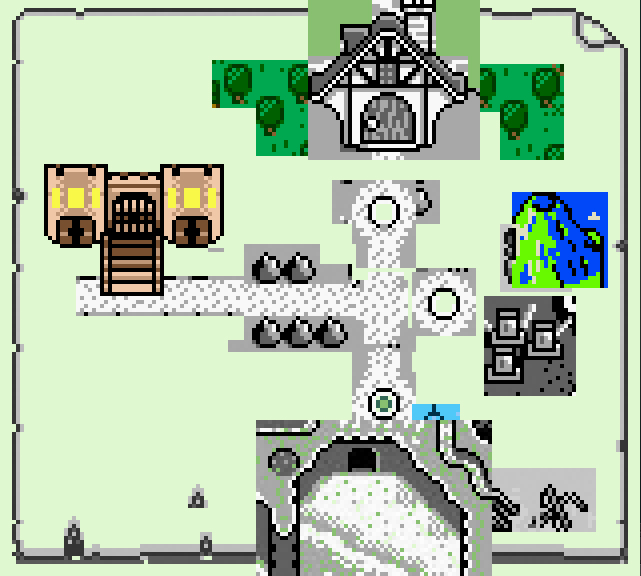
Once you’ve selected a location, you’ll move to the first area to fight a gang of enemies. Once defeated, you’ll gain experience points and move along to the next area of enemies. Each location will have three areas each to visit, and the third area of each location will contain a boss battle. The more you battle, the easier time you’ll have taking down an enemy in battle. After conquering all nine areas, a challenger will approach you, triggering the tenth and final combat scenario.
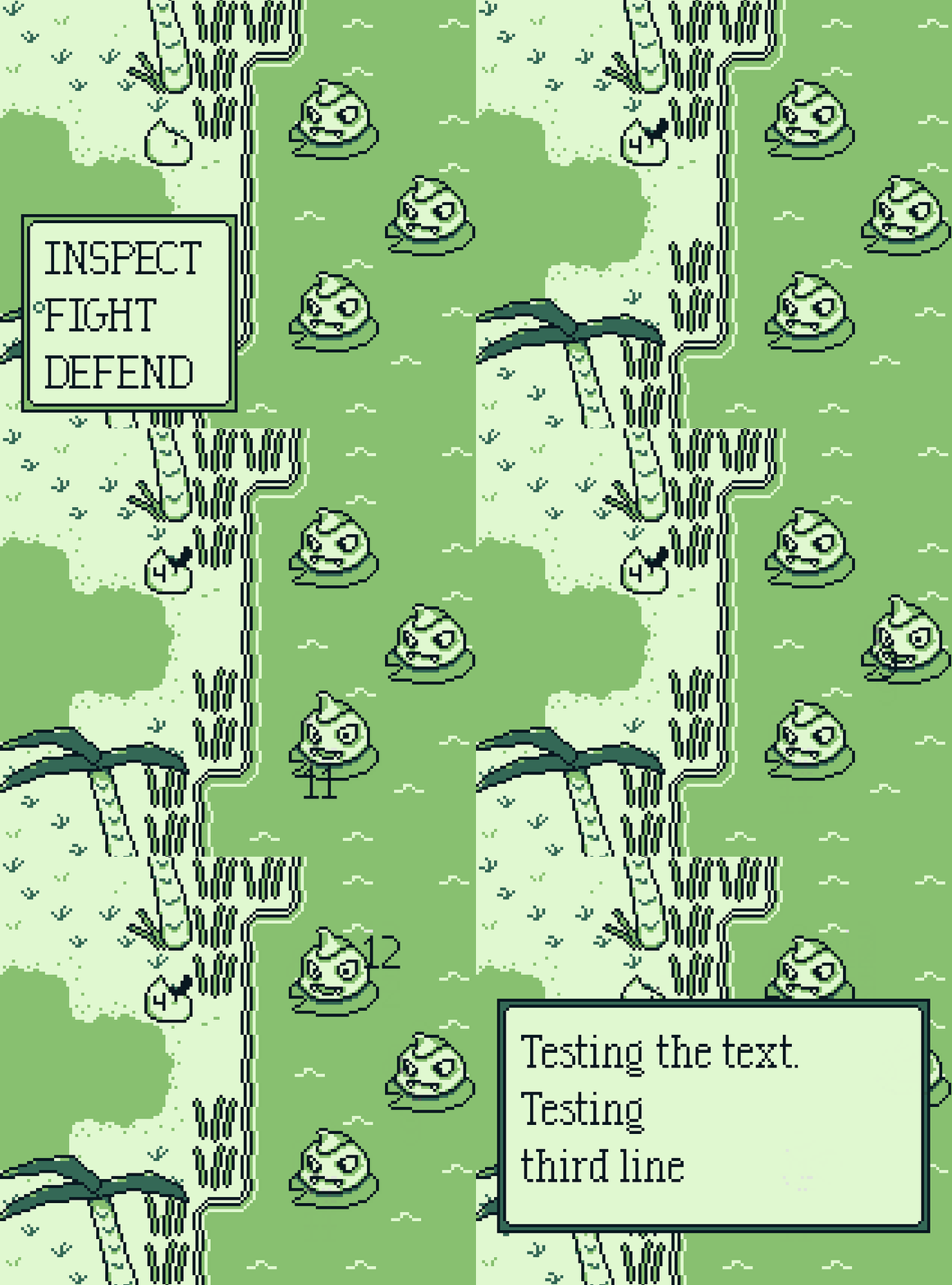
This might sound like a long and tactical stretch of the demo but I’m building the combat to be breezy and entertaining above all else. The two actions you can take are FIGHT and DEFEND, while the INSPECT option will provide flavor text about the enemy based on your current position in battle. The centerpiece of this war game will be the context-sensitive text to read along the way. This isn’t quite a game any more than a Choose Your Adventure book but between the fast progression and the fact that the lack of “correct options” is obscured by the player during their playthrough, both things I hope will keep the player engaged and curious of what is happening both plot wise and within the code.
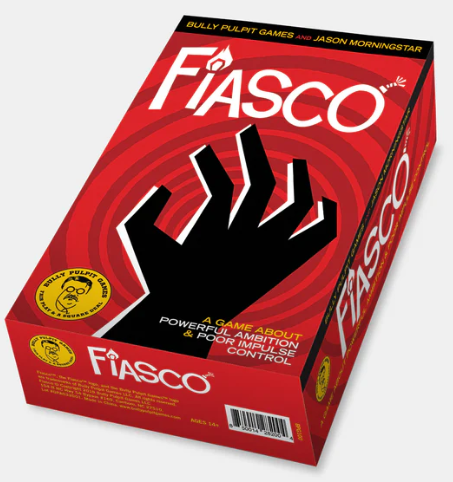
The inspiration for these “no wrong answers” battle scenarios come, at least in part, from a table-top role-playing game called Fiasco. In the game, you and a couple of your friends build your own silly crime drama, both characters and plot, and stumble your way through different scenes as they play out. During rounds of gameplay, actions your character takes will either have positive or negative outcomes. Negative outcomes are not explicit failures but a bad or undesirable turn in your character’s story. So, for example, if you are playing the role of a drug dealer selling cocaine in a shopping mall and wind up with the ‘negative outcome’ of being caught by mall security, you might end up in the security office, the setting of the next scene or round of gameplay. This might actually benefit you in the narrative as you may, for example, meet another criminal in the security office that can assist you. This type of “yes, and…” mechanic draws from the foundational principle of improv comedy, validating/accepting an action and then expanding on it. If a player chooses to only defend and never attack, I’d like for that to result in an outcome just as interesting as choosing to attack every round. This does mean I’ll be writing a lot of bespoke dialogue for many possible outcomes, but I plan to both embrace this as a fun writing exercise and lock in the scope so it doesn’t expand into an even more complicated mechanic.
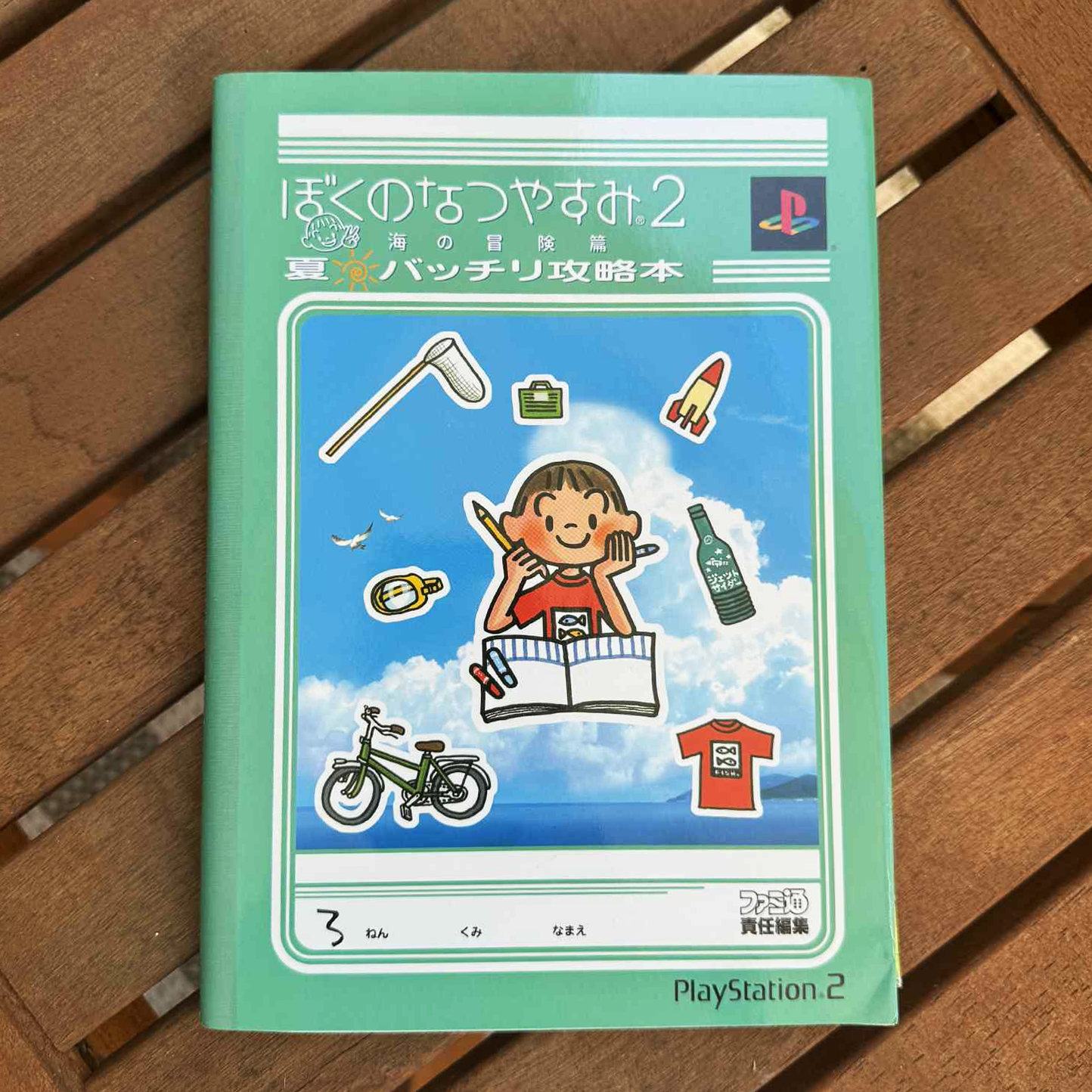
The official guide for Boku no Natsuyasumi 2 imported from Japan
There’s another game I’ve been thinking about a lot that weaves a battle mechanic into its emotional and breezy narrative: the 2002 Japanese-exclusive PS2 game Boku no Natsuyasumi 2: Umi no Bouken-hen (or My Summer Vacation 2: Adventure by the Sea). I first learned of this game through video game essayist and game developer Tim Rogers (he has a very interesting and thorough 6-hour review of the first game). Although the Boku no Natsuyasumi series was never translated and sold in America, in 2023 a translator who goes by Hilltop Works posted an unofficial English translation of Boku no Natsuyasumi 2, which is how I was able to play the game.
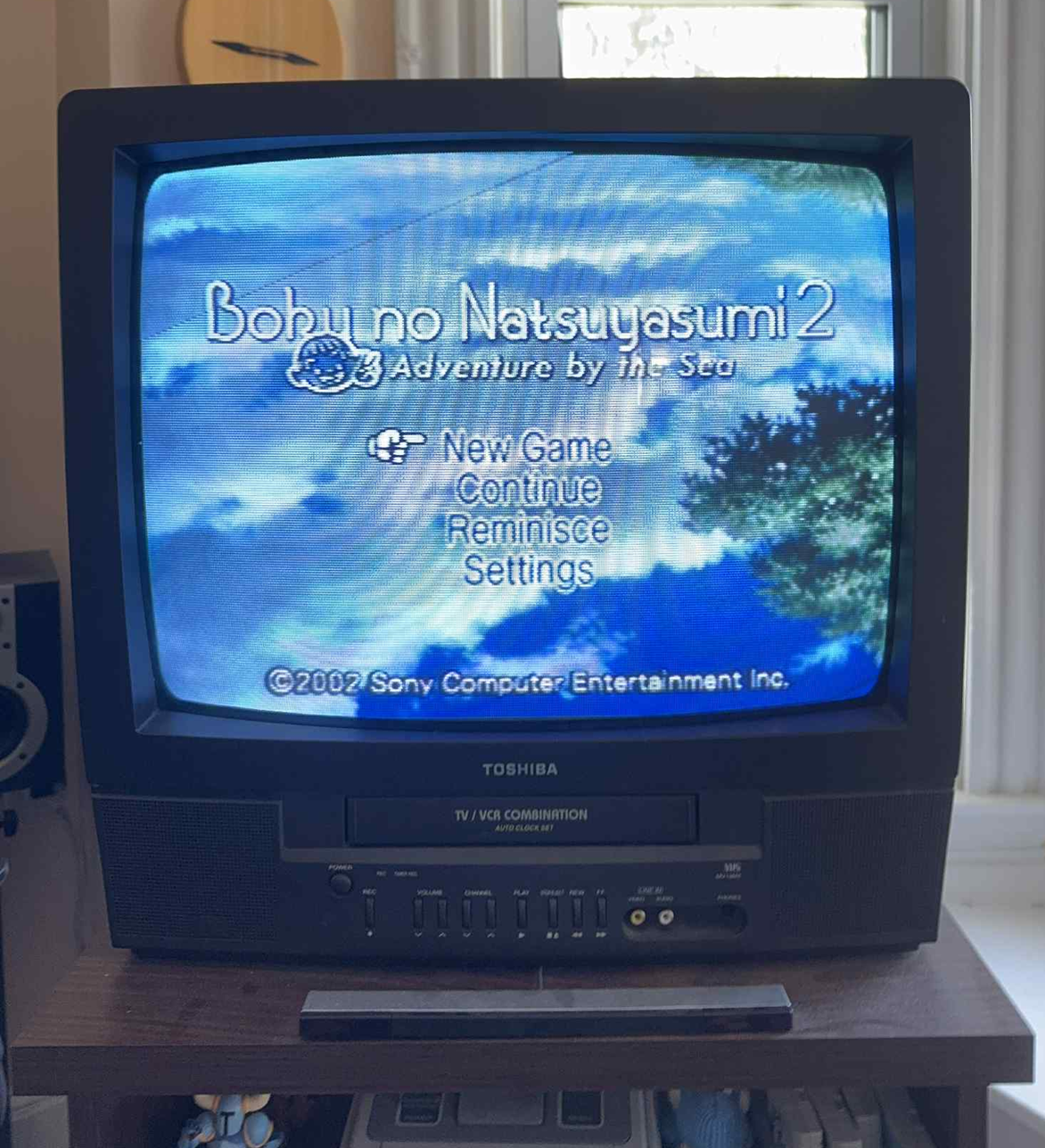
With a soft-modded PS2 and a patched version of the game, I was able to load it onto a flash drive and get it to run. I played the game last summer over the month of August with my PS2 plugged into a CRT, trying to get as close to the authentic gameplay experience as possible.
But what is this game, and what makes it so special? Well, Boku no Natsuyasumi 2 is an open-world simulation game set in a small rural town in August 1975 where you play as Boku, a nine-year-old boy who is staying at his aunt and uncle’s while his parents prepare for the birth of their second child. The game simulates the casual openness of summer vacation as a curious latchkey kid with no schedule and no obligations. When you wake up in the morning, you take part in morning calisthenics and then have breakfast with your aunt, uncle, and cousins (these two activities are presented as cutscenes) before you are let loose to explore Fumi, the small coastal town only accessible by boat. From there you can catch bugs, swim, fish, make friends with the neighbors, pet a dog, or take a stroll through the woods.
But what is this game, and what makes it so special? Well, Boku no Natsuyasumi 2 is an open-world simulation game set in a small rural town in August 1975 where you play as Boku, a nine-year-old boy who is staying at his aunt and uncle’s while his parents prepare for the birth of their second child. The game simulates the casual openness of summer vacation as a curious latchkey kid with no schedule and no obligations. When you wake up in the morning, you take part in morning calisthenics and then have breakfast with your aunt, uncle, and cousins (these two activities are presented as cutscenes) before you are let loose to explore Fumi, the small coastal town only accessible by boat. From there you can catch bugs, swim, fish, make friends with the neighbors, pet a dog, or take a stroll through the woods.
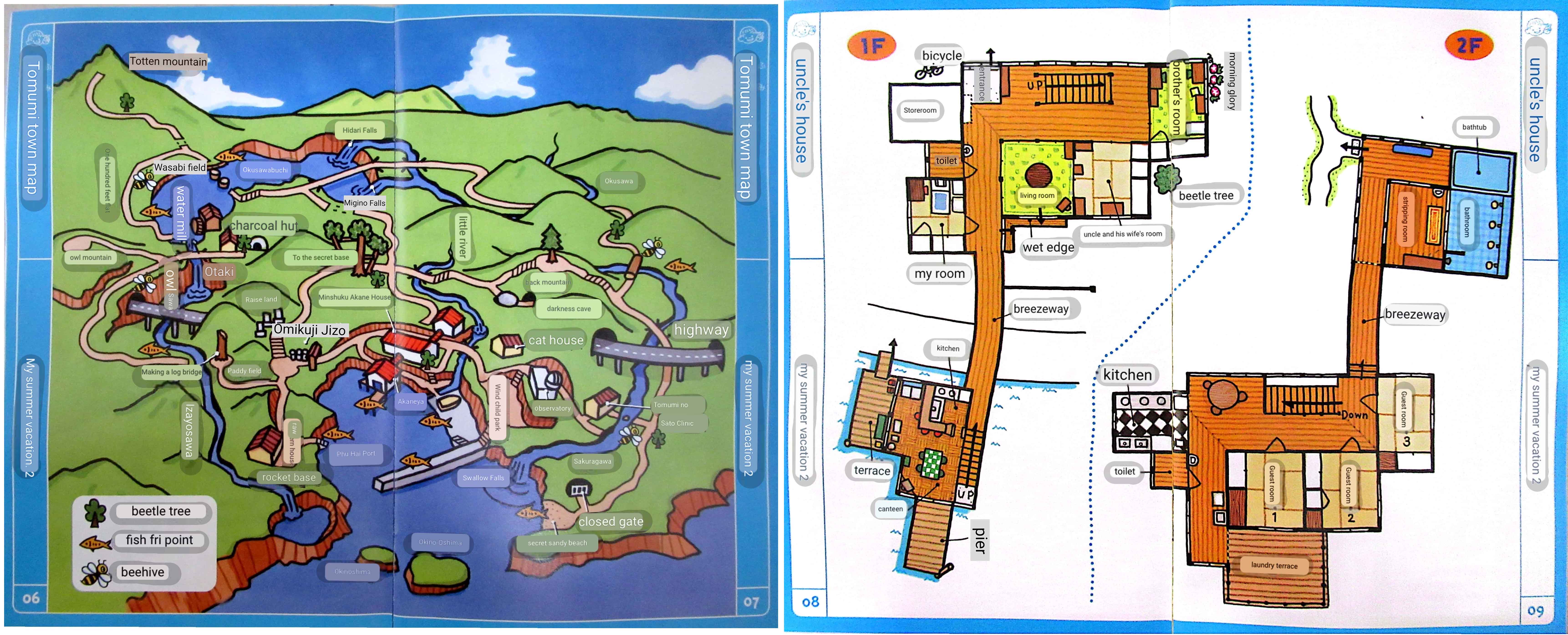
A map of the town of Fumi (left) and the aunt and uncle’s domicile/bed and breakfast (right) scanned and translated with Google Translate by reddit user harlekinrains
You play as little Boku as you navigate the space with the somewhat clumsy tank controls (use the X button to walk forward and left/right arrows to change directions), moving from static location to static location. Walking to the edge of the screen or entering a door will bring you to the next location.
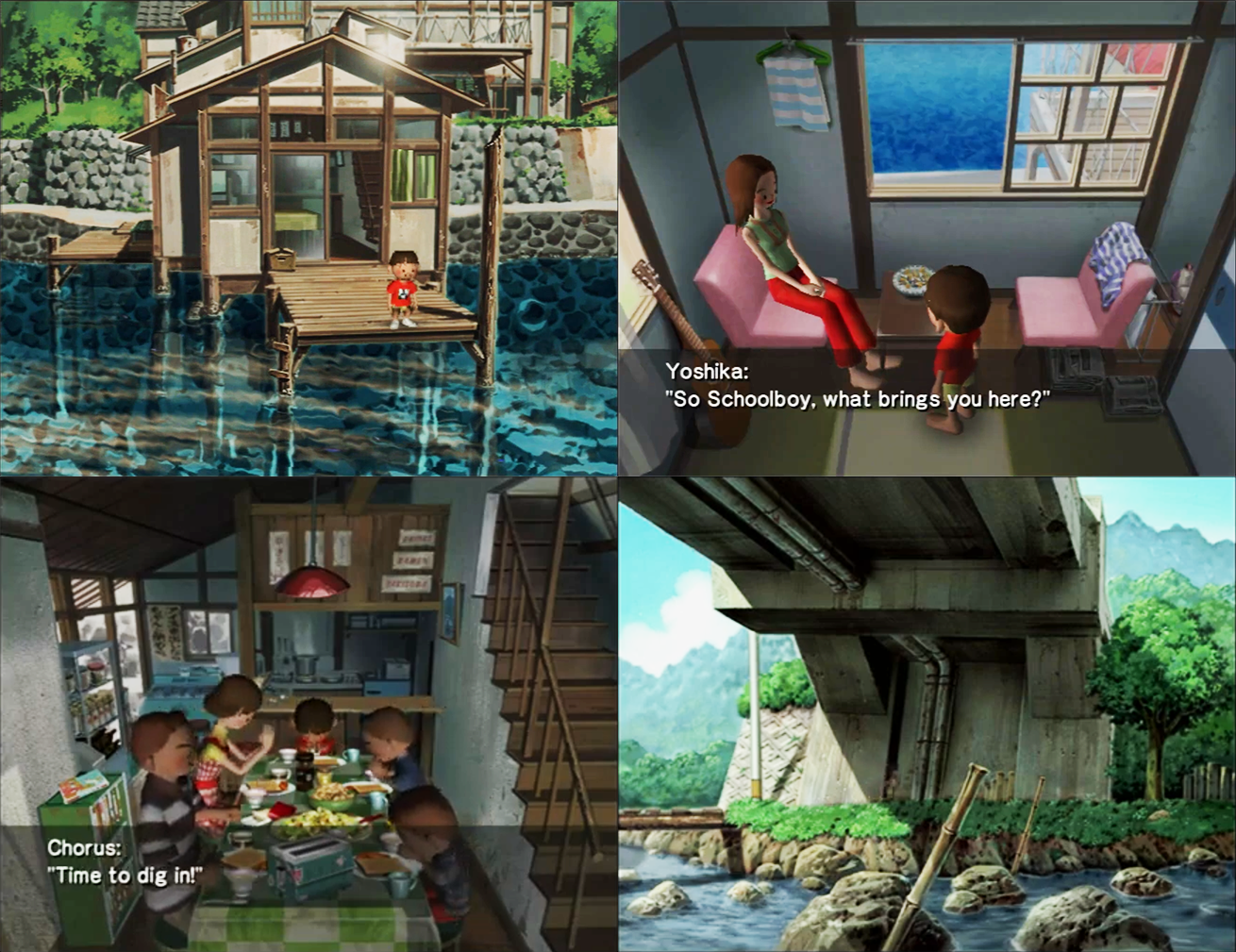
But what really makes the physical space so endearing is that every location on the map has a fixed-camera point of view. Boku moves through the landscape in third person and our perspective of him only changes when he reaches a new spot. The characters and some objects are modeled in 3D, but the backgrounds are beautifully illustrated, giving the game an aesthetic closer to anime or film than what you’d usually see in a video game. The game has a lush, realistic soundscape that changes as you move to new locations. Wind, waves from the ocean, bird calls, insects, the sound of Boku’s footsteps along a path.
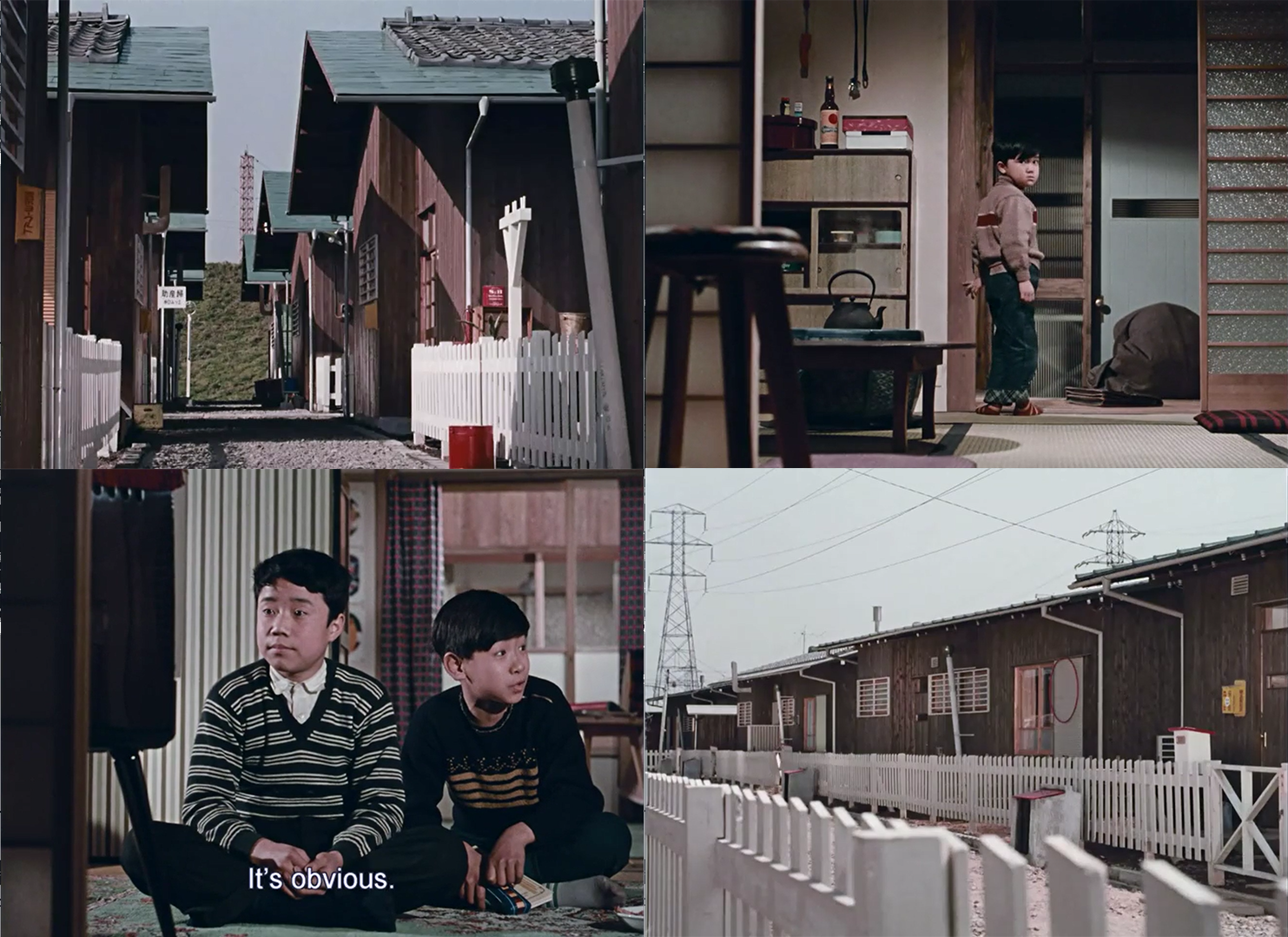
The game often reminds me of the work of prolific 20th century Japanese director Yasujirō Ozu, especially his 1959 film Good Morning. The film captures domestic family life through the lens of two brothers as they try to convince their dad to buy them a TV. The film explores generational differences and communication, but it’s also so wonderfully shot and composed. It too captures the authenticity of a child’s perspective and playfulness. I imagine if Ozu had the chance to make a video game, it might look and feel like Boku no Natsuyasumi.
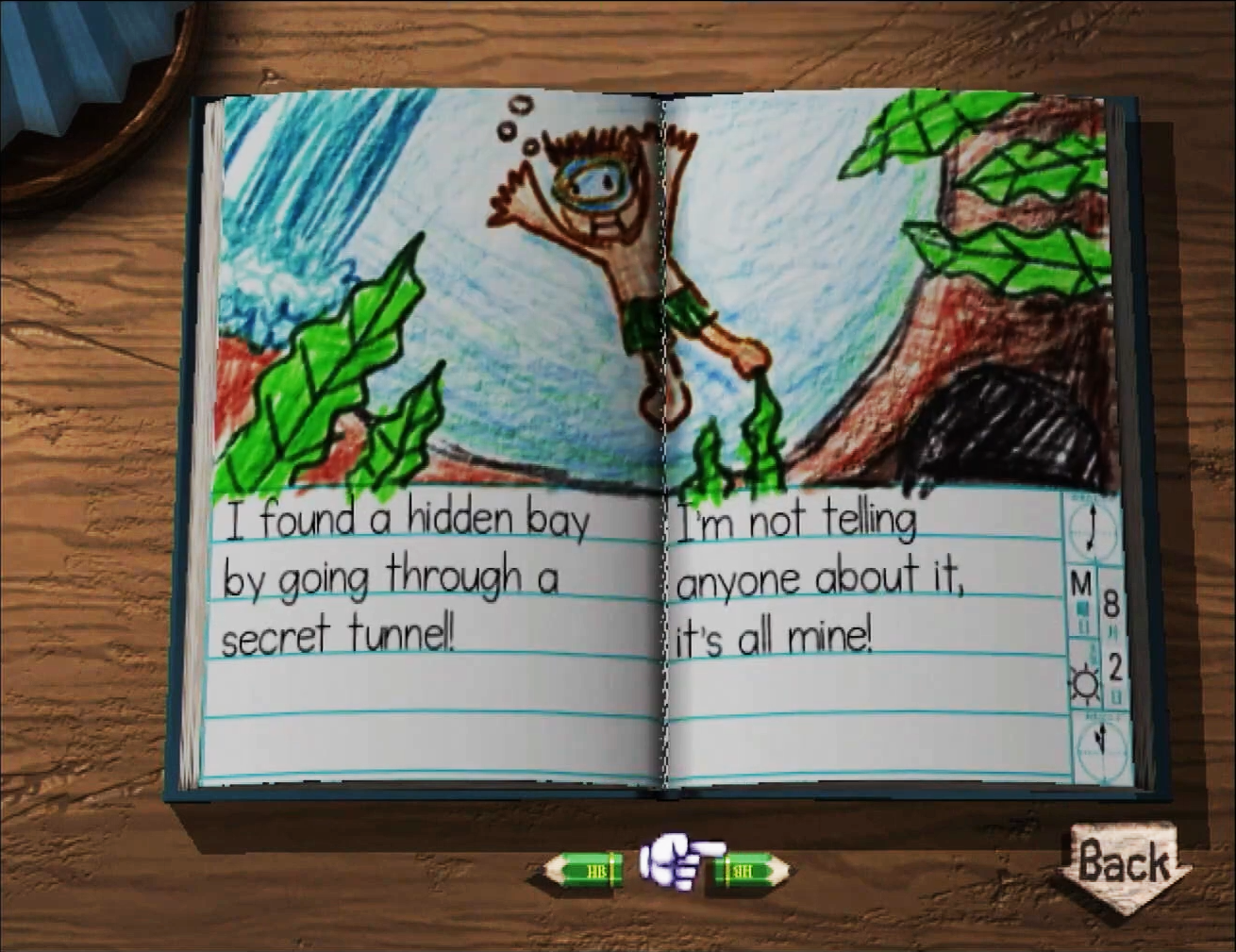
Time slips forward incrementally every time you move to a new location and before long you are called in for supper. Then you have a few hours to kill before it’s time to go to bed. This gameplay loop encapsulates the entire game, playing out one day at a time until it’s time for you to go back home on August 31st to greet the new school year and a new sibling. But for the month of August, you are free to do anything, even swim all summer if you want. But like any nine-year-old on summer vacation, you find some way to occupy your time.
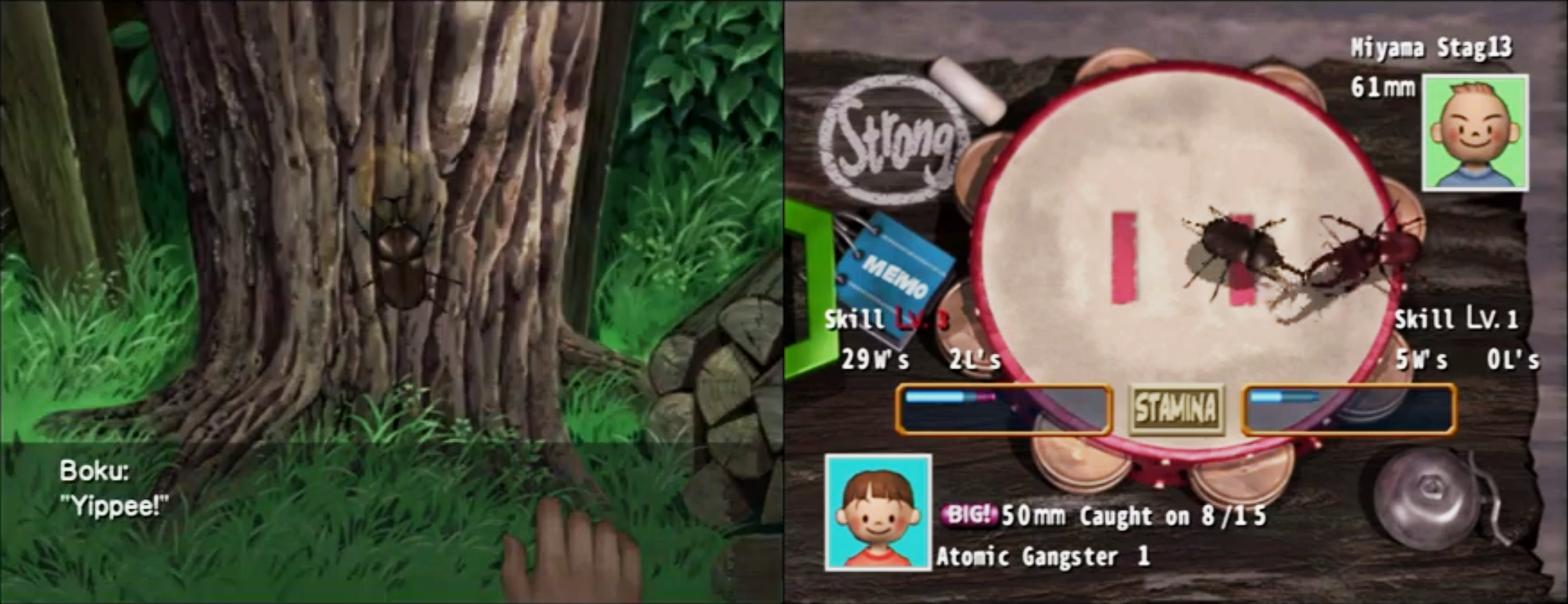
Catching a beetle (left) and then battling that beetle on top of a tambourine (right) as featured in Boku no Natsuyasumi 2
The game features a fully optional but decently fleshed-out mini-game where you collect insects and battle with them sumo-style. I have heard collecting and fighting beetles is a common activity among kids in Japan, even inspiring the creator of the Pokémon games Satoshi Tajiri (with the childhood nickname “Dr. Bug”), who would have been roughly Boku’s age back in 1975. When I played through Boku no Natsuyasumi 2, I didn’t catch a lot of bugs or have them fight, but knowing the option was always there for me if I wanted to engage with it gave the game an air of richness and completeness.
The first three games in the Boku no Natsuyasumi series all take place in August 1975 following Boku, but in each game you are visiting a different aunt and uncle. The first takes place in the countryside (released in 2000 on the PS1), the second by the seaside (released in 2002 on the PS2 and the only entry in the Boku series with a fan translation), and the third on a farm (released in 2007 on the PS3). There are several sequels and spiritual sequels all developed by Millennium Kitchen, a company founded by Kaz Ayabe. Ayabe is credited as the creator and director of the Boku series. These games are not for everyone, but I do highly recommend checking out some footage on YouTube of Boku no Natsuyasumi 2 to get a better sense of the moment-to-moment gameplay as I just don’t feel like I can do it justice with the written word alone.
The first three games in the Boku no Natsuyasumi series all take place in August 1975 following Boku, but in each game you are visiting a different aunt and uncle. The first takes place in the countryside (released in 2000 on the PS1), the second by the seaside (released in 2002 on the PS2 and the only entry in the Boku series with a fan translation), and the third on a farm (released in 2007 on the PS3). There are several sequels and spiritual sequels all developed by Millennium Kitchen, a company founded by Kaz Ayabe. Ayabe is credited as the creator and director of the Boku series. These games are not for everyone, but I do highly recommend checking out some footage on YouTube of Boku no Natsuyasumi 2 to get a better sense of the moment-to-moment gameplay as I just don’t feel like I can do it justice with the written word alone.
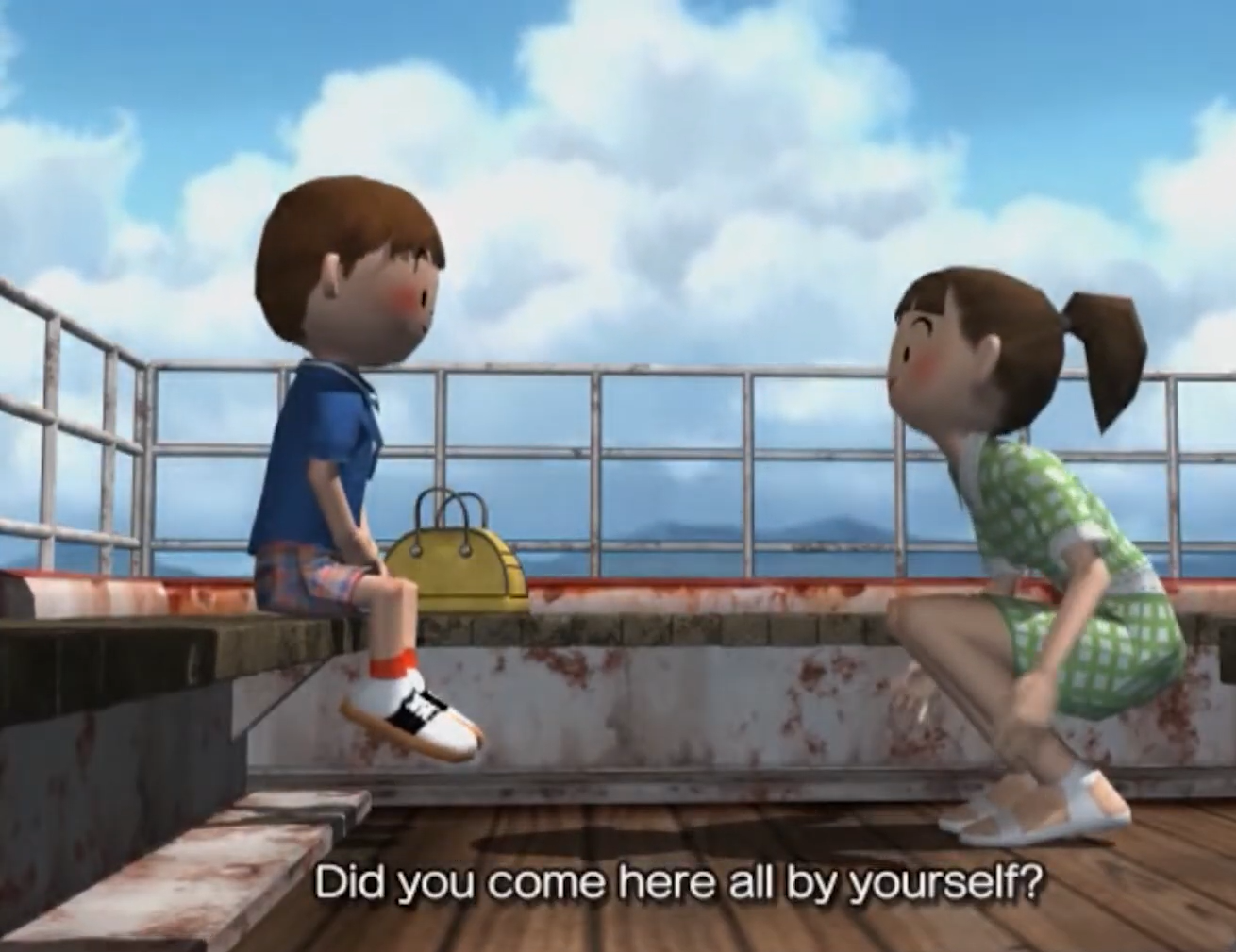
At the end of August, near the end of my playthrough of the game, I spoke to Yasuko, the 16-year-old neighbor girl who is the first character you meet on the ferry to Fumi. As she laments the end of summer and her eventual return to school, she mentions that when she returns the following summer, things won’t be the same. She says a new highway system is going to make Fumi more easily accessible. More transportation means more people. She will be off to college soon and her hometown won’t ever be the same again. For Boku, he is an older brother now. The summer slips away. Things change.
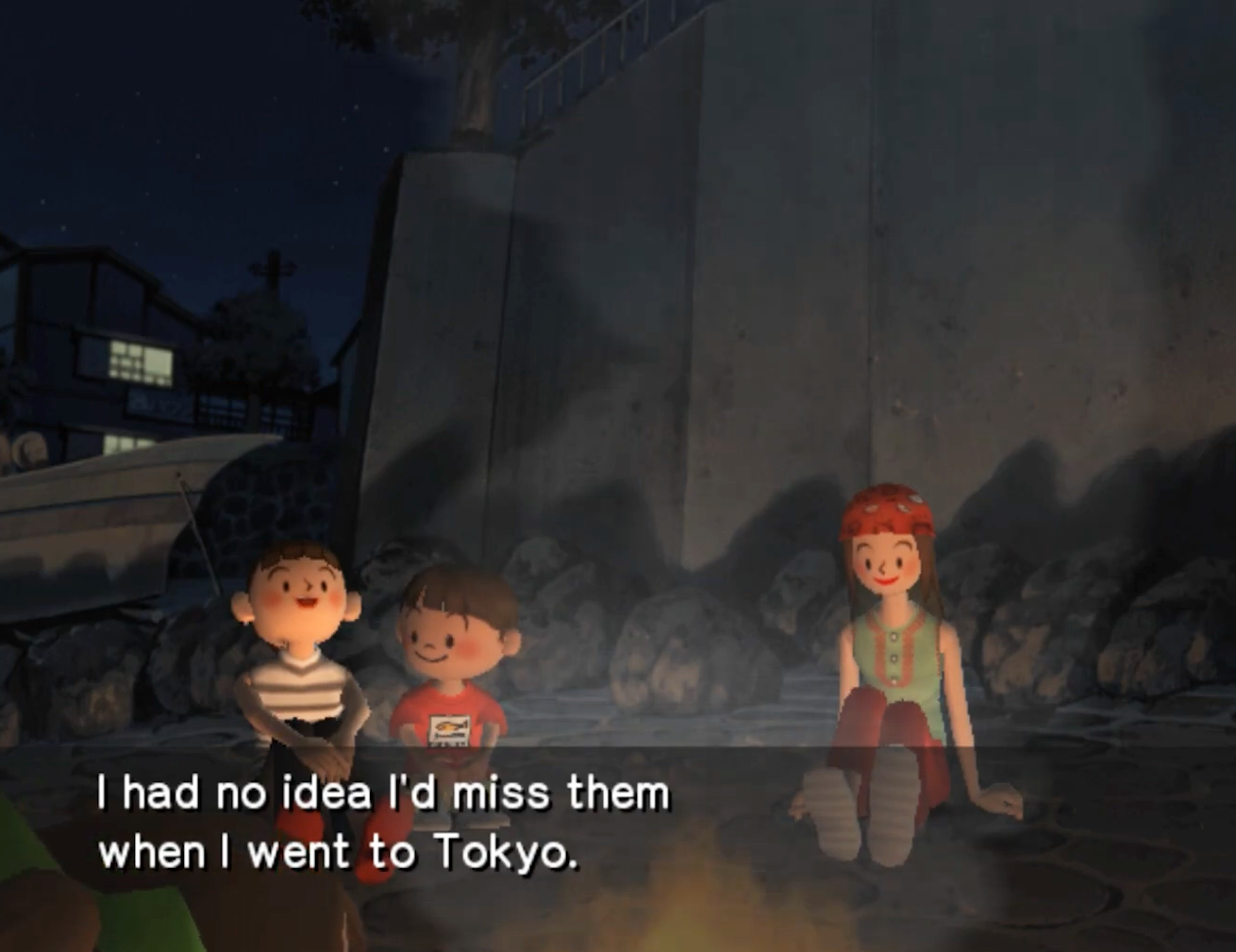
I did a bunch of research about the nature of nostalgia and its ties to rural locations, simpler times and bygone eras. While this line of thinking can breed toxicity both personally and politically, indulging in the fantasy and whimsy of your own cherished memories or the memories of others - in fiction or autobiography, presented and sold to be experienced and borrowed – can be comforting, cathartic, and often bittersweet.
The song Take Me Home, Country Roads by John Denver is a crystalline encapsulation of rural nostalgia. I decided to give it a fresh listen with nostalgia on the mind. I found the top comment on the song’s YouTube video particularly interesting…
The song Take Me Home, Country Roads by John Denver is a crystalline encapsulation of rural nostalgia. I decided to give it a fresh listen with nostalgia on the mind. I found the top comment on the song’s YouTube video particularly interesting…
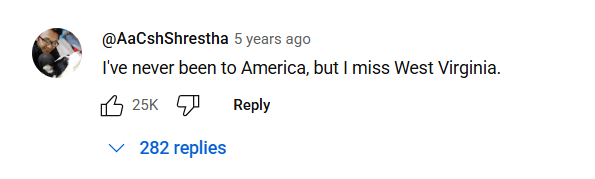
Scrolling down, reading more comments, you see that this is a common sentiment. The song still resonates deeply with people all around the world. I’m reminded of this speech from Mad Men delivered perfectly by Jon Hamm’s Don Draper, a man who makes a living off of telling people the story they want to hear:
My first job, I was in house at a fur company with this old pro copywriter, Greek, named Teddy. And Teddy told me the most important idea in advertising was ‘new.’ Creates an itch. You simply put your product in there as a kind of calamine lotion. But he also talked about a deeper bond with the product: nostalgia. It’s delicate, but potent. Teddy told me that in Greek nostalgia literally means ‘the pain from an old wound.’ It’s a twinge in your heart, far more powerful than memory alone.
This device isn’t a spaceship. It’s a time machine. It goes backwards, forwards. Takes us to a place where we ache to go again. It’s not called ‘The Wheel.’ It’s called ‘The Carousel.’ It lets us travel the way a child travels. Around and around and back home again to a place where we know we are loved.
Draper here is pitching an ad for a slide projector. A novel way to view your old photos. I want to say he's vastly overselling the transportive power of the photograph, but there's enough truth in his words that I accept it.
I live within a mile of Boston’s Arnold Arboretum. It’s a tree museum and botanical park affiliated with Harvard University. It’s well maintained, and in the summer, it is lush and green. A perfect escape from the city. I plan to go for a run through the Arboretum the moment I finish writing this.
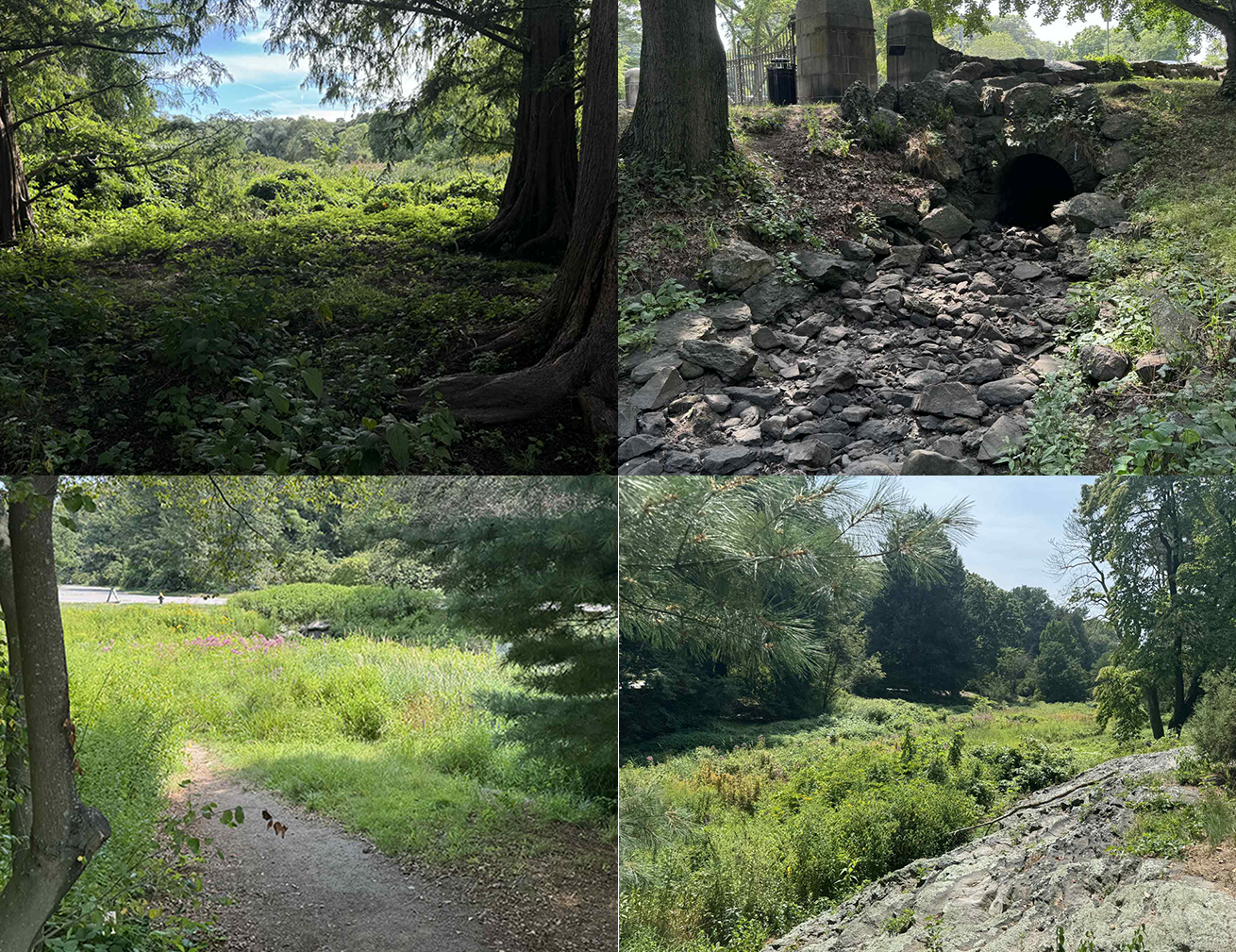
Ever since playing Boku No Notsuyasami 2, it’s hard for me not to think about the game when I’m there.
I’ve never been to Japan, but I miss Fumi.
I hope you’ve found some peace and relaxation this summer. Not only has it been 50 years since Boku’s summer vacation, but this summer is also the 50th anniversary of Jaws! I highly recommend a rewatch if it’s been a while. And if you’ve never seen it, you’re in for a treat.
Sincerely,
Neil