Originally published on September 30, 2025

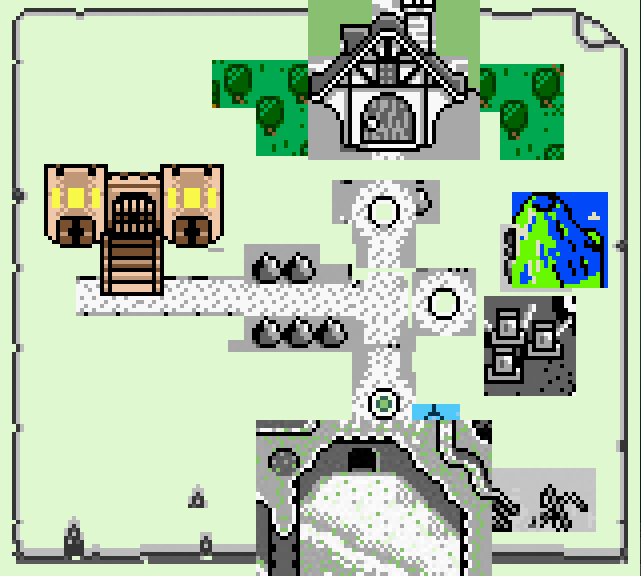
This month has been a very productive month for Sad Land! After including the mockup of the war map in June and August’s newsletters, I pushed myself to create some polished artwork to share. Below is the original placeholder art that I cobbled together from several different retro games…
And now here’s the new version with my own original artwork…
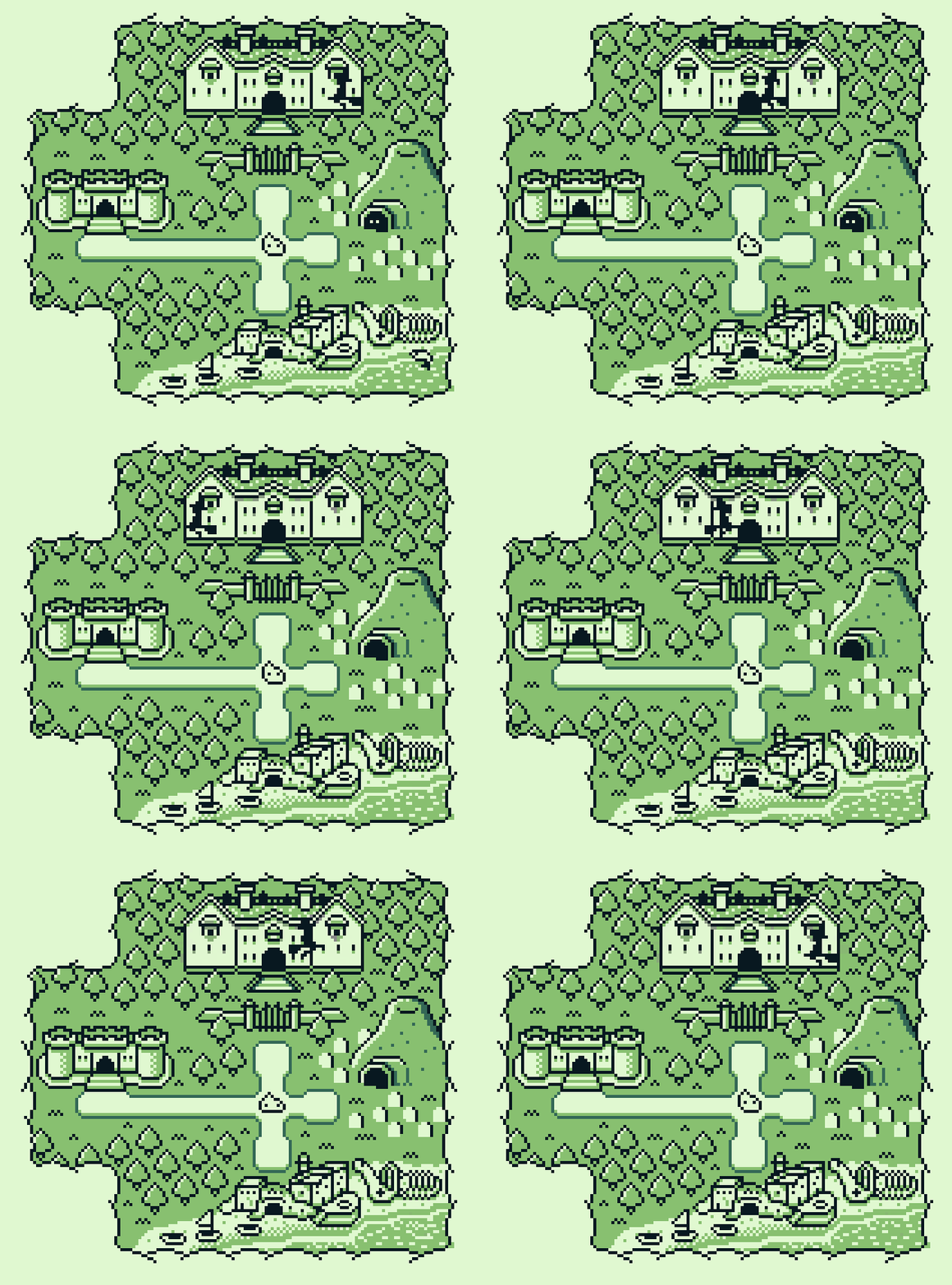
Although I did scour NES and SNES game maps for some design inspiration, I also looked to old English manor houses for the estate to the north and the Italian coastal city of Manarola for the beachside area to the south. The witch, eyes in the cave of the volcano, and the fish were added to give the map some movement and character, but the large, beached whale skeleton was the last item added and the thing I feel gives the map an air of cohesion and mystery. It’s a little homage to the whark skeleton you encounter early on in Uru: Ages Beyond Myst. I’ve always loved how strange, alien, and ominous it is.
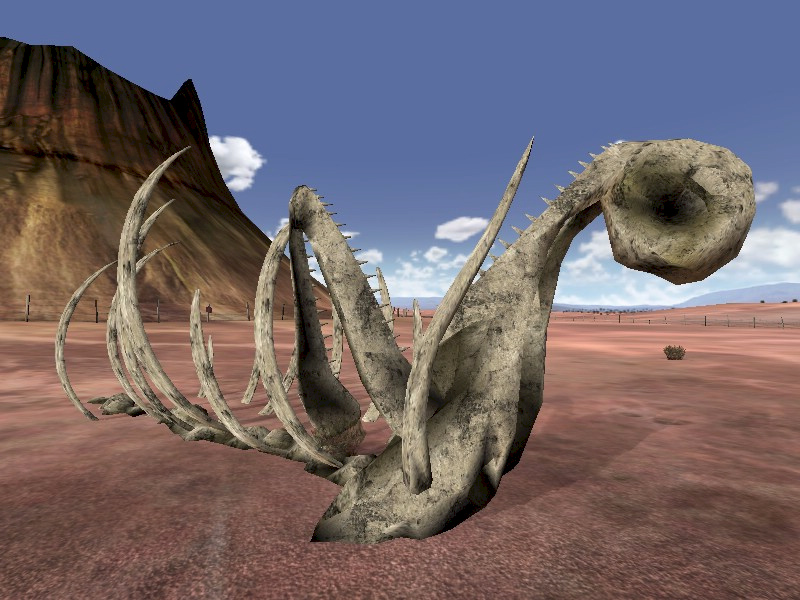
Image retrieved from The Lost Library of D'ni
With the warmest months behind us and the winter approaching, I have the intention to release a playable demo for Sad Land before 2026 with my sights set on a 15-minute vertical slice. Lots of pixel art, character design, dialogue, music, and functional systems are complete: now I just have to piece them together in a bite-sized and cohesive experience.
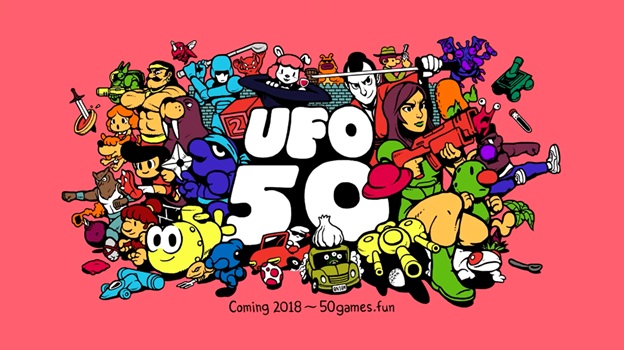
My Year of UFO 50
Back in 2017, indie game developer Derek Yu announced two new projects. One was Spelunky 2, a sequel to his 2012 hit platformer Spelunky, and the other was UFO 50, a collection of 50 retro-inspired games designed in collaboration with a short list of other indie developers. You may not have heard of Derek Yu unless you follow the world of indie games, but between winning the prestigious Seumas McNally Grand Prize at the 2007 Independent Games Festival for his first commercial game Aquaria (co-developed with Alec Holowka), running TIGSource for many years (a popular indie game forum/news site), helping jumpstart the popularity of the roguelike/roguelite genre, and writing about the process and art of video game development, Yu is a well-respected member of the gaming community. David Lynch is a filmmaker’s filmmaker, Kate Bush is a musician’s musician, and Derek Yu is a game developer’s game developer.
His game Spelunky 2 missed its launch window by a year, coming out September of 2020, but game development releases are hard to predict even for experienced developers. UFO 50 also missed its launch window. 2018 came and went. And so did 2019. And then 2020. Every year that went by I would check up on the project for signs of life. It was clear that the project was still gestating with plans for release but no news of when.
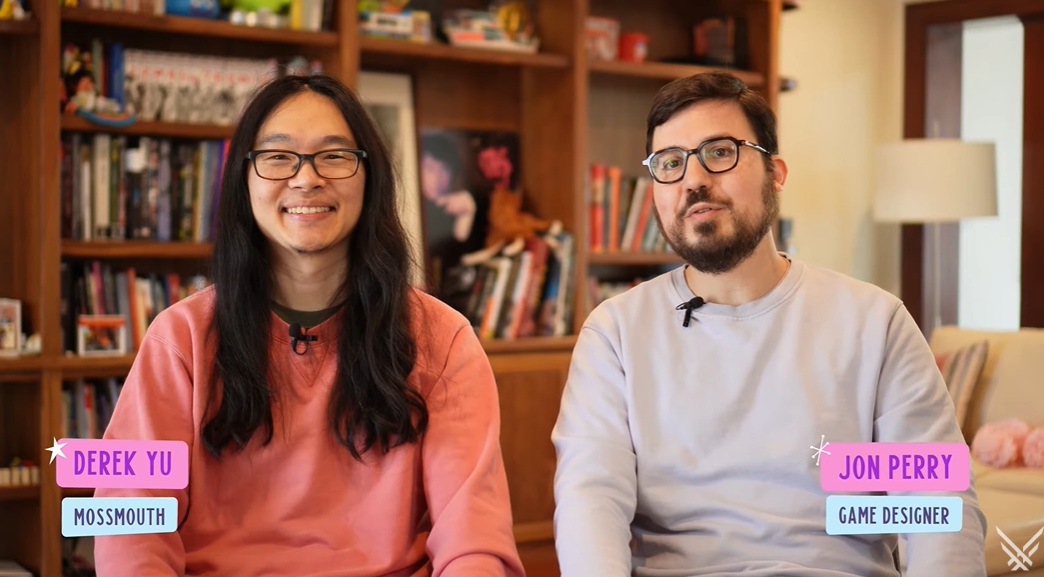
Fast forward to summer 2024. During the Day of the Devs: Summer Game Fest, an annual showcase of interesting and creative independent games presented by Double Fine Productions and iam8bit, Derek Yu and Jon Perry, one of his UFO 50 co-developers, released a big announcement. UFO 50 was finally near completion and would be released in September. After starting the project in 2015, the six developers would finally unveil their offbeat pet project to the world. For some more context on the game itself, here’s how Derek and Jon introduce their game in the video…
Fast forward to summer 2024. During the Day of the Devs: Summer Game Fest, an annual showcase of interesting and creative independent games presented by Double Fine Productions and iam8bit, Derek Yu and Jon Perry, one of his UFO 50 co-developers, released a big announcement. UFO 50 was finally near completion and would be released in September. After starting the project in 2015, the six developers would finally unveil their offbeat pet project to the world. For some more context on the game itself, here’s how Derek and Jon introduce their game in the video…
Derek: Hi, I’m Derek.
Jon: I’m Jon. And we’re part of the team of indie developers working on UFO 50, a collection of fifty games.
Derek: You heard that correctly. That’s fifty brand new games.
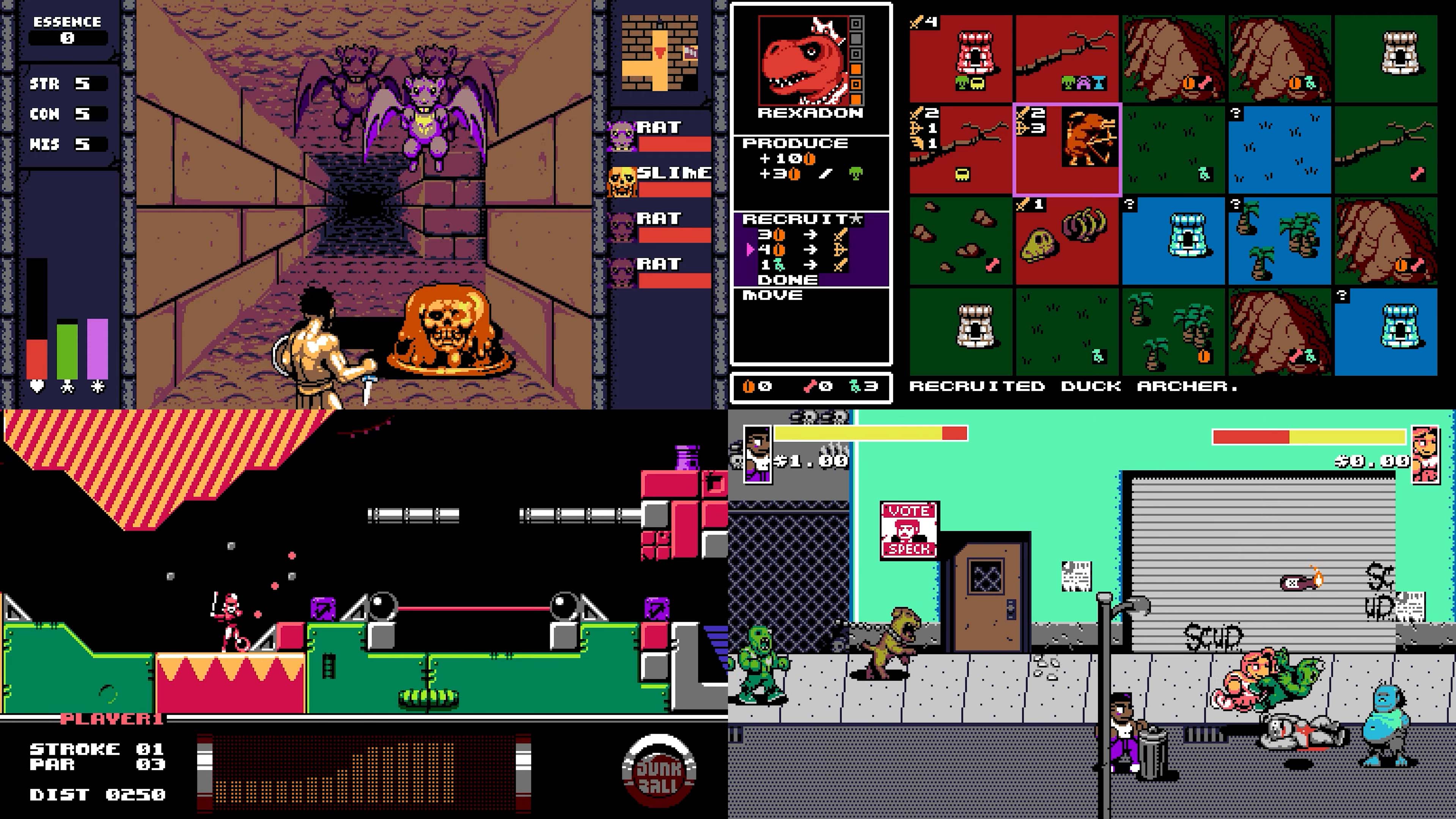
Jon: First and foremost, these are not minigames. Some of the games are smaller, like arcade-style games. Others are quite large with expansive worlds to explore. But every single game is a complete experience, from its opening title screen to its end credits.
Derek: There’s a story that connects all these games too. We invented a fictional company called UFO Soft to develop these games for a fictional 80s game console. This company’s history spans from 1982 to 1990, and the games get more technically advanced as the years go on. And as you explore the timeline, you’ll find that some games have sequels or recurring characters.
Jon: We also thought about the limitations of the hardware. We devised a strict 32-color palette as well as audio restrictions to make it feel like you’re in the world of UFO 50 no matter which game you’re playing.
Derek: But one area where we didn’t limit ourselves is in the games’ designs. We were happy to build on modern game designs and genres, and we strived to make sure that each game felt like a unique experience. Our goal isn’t just to remind you of a bygone era, it’s also to provide fifty fresh experiences.
Jon: I’m Jon. And we’re part of the team of indie developers working on UFO 50, a collection of fifty games.
Derek: You heard that correctly. That’s fifty brand new games.
Jon: First and foremost, these are not minigames. Some of the games are smaller, like arcade-style games. Others are quite large with expansive worlds to explore. But every single game is a complete experience, from its opening title screen to its end credits.
Derek: There’s a story that connects all these games too. We invented a fictional company called UFO Soft to develop these games for a fictional 80s game console. This company’s history spans from 1982 to 1990, and the games get more technically advanced as the years go on. And as you explore the timeline, you’ll find that some games have sequels or recurring characters.
Jon: We also thought about the limitations of the hardware. We devised a strict 32-color palette as well as audio restrictions to make it feel like you’re in the world of UFO 50 no matter which game you’re playing.
Derek: But one area where we didn’t limit ourselves is in the games’ designs. We were happy to build on modern game designs and genres, and we strived to make sure that each game felt like a unique experience. Our goal isn’t just to remind you of a bygone era, it’s also to provide fifty fresh experiences.

Later that summer, I learned that my favorite video game podcast Eggplant: The Secret Lives of Games would be doing a special A Year of UFO 50 podcast event, an idea co-host Nick Suttner, a writer, game designer, and consultant who worked at PlayStation and then Oculus before going independent, first dreamt up shortly after the initial announcement trailer dropped for UFO 50 seven years prior. Nick, along with his team of co-hosts, a well-rounded group of gaming professionals with experience in game development, education, and consulting, planned to release one episode of the show every week to discuss one of the games as well as two additional episodes, one to introduce the series and one to wrap it up.
I’m not sure how I would have approached the collection without the podcast, but knowing I’d have a book club format to follow along at home and a panel of intellectuals to unpack each game week after week made me that much more excited for the game’s release.

A set of pixel-art profile pictures by Derek Yu of UFO 50’s development team
Before last year, I didn’t spend a lot of time interacting with strangers on the internet, outside of sending out this newsletter, but when the Eggplant podcast created a section in their public discord server for the show’s community to discuss the games of UFO 50, I dove right in. Between playing the games, listening to the podcast, and following the community discussion, I was ready for an extensive and full year of UFO 50.
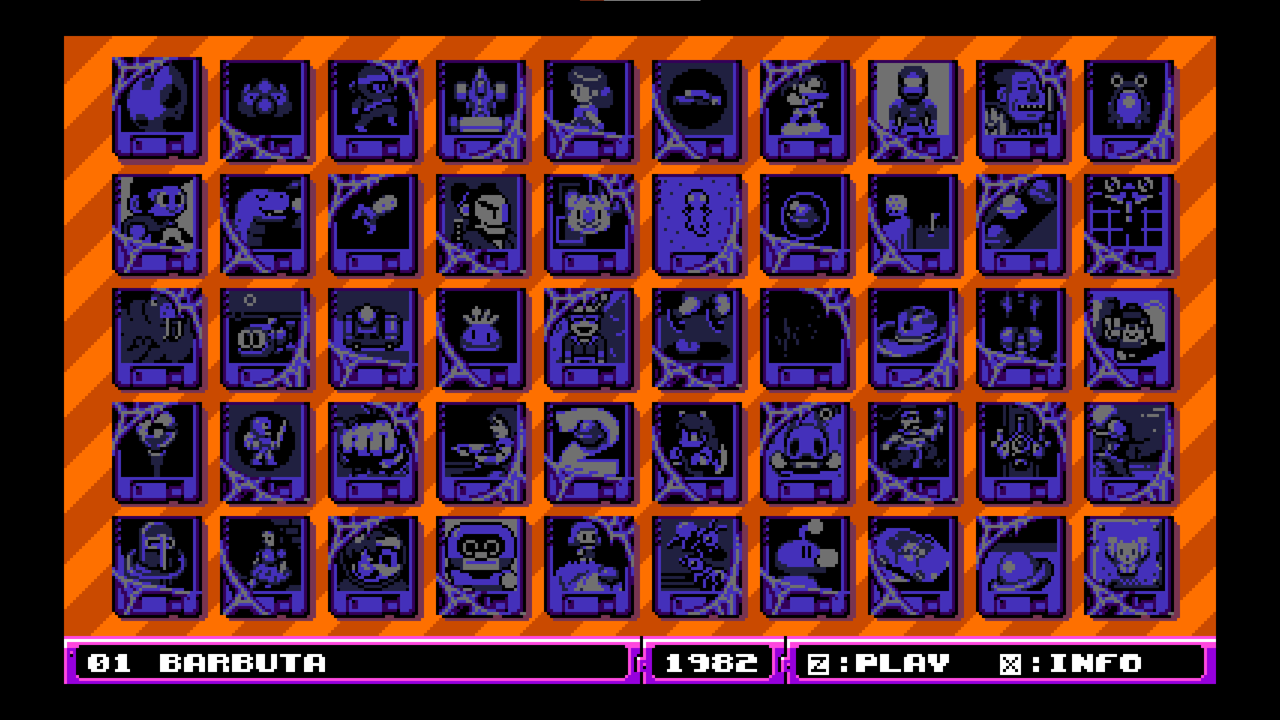
I purchased the game the day it went on sale and, after getting through the game’s introduction and title screen, was greeted with the game select screen, a grid of games darkened by dust and cobwebs. As you move your selector over them, the game will offer up a title to go along with the game’s artwork and the year the game was released according to the metanarrative. When you select a game for the first time, the dust comes off the game’s icon, helping you track which games you’ve already booted up. You can play the games in any order, leaving the playstyle up to you. Will you play the games in a strict chronological order or opt to jump around? I bounced around from the get-go and would commit to four games at a time, one that stuck to what the book club was covering and three others that seemed interesting.
I’m writing this now on the other side of the collection, over 300 hours logged in the game, every Steam achievement unlocked (something currently only .2% of players on Steam have tackled), with well over 52 hours listening to the podcast series, and countless hours reading comments and sometimes contributing to the conversation myself.
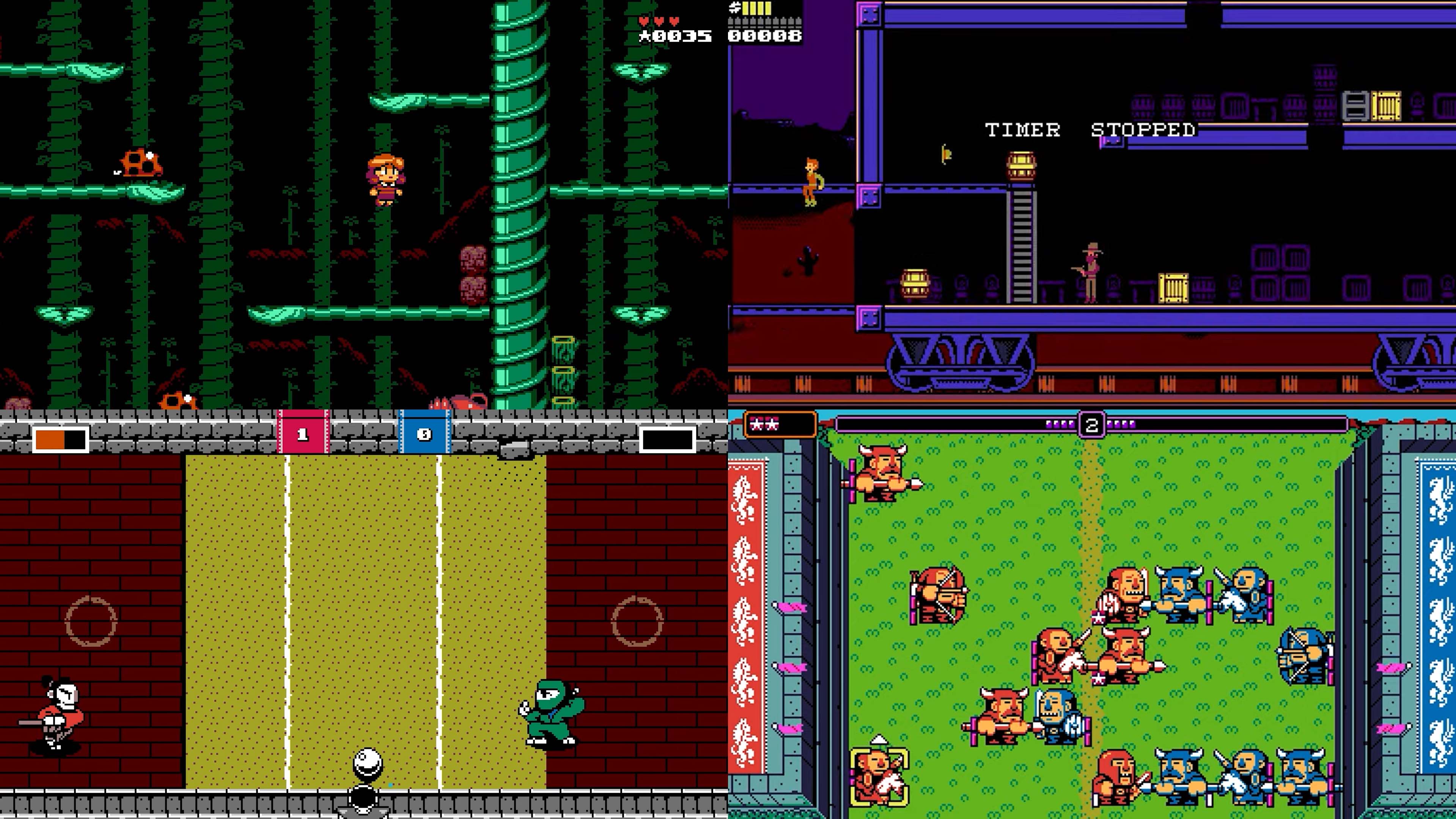
Committing to the book club format and spending more time than I might have normally spent on each title meant that I didn’t “find the fun” with some games until I had spent several hours flailing and struggling. There were several times I reached a difficult point in a game in the collection where I couldn’t fathom how or when I’d be able to get through it. In a slower-paced game I might not initially understand certain tactics or mechanics and for a faster-paced game that is more technically challenging, it would often come down to just spending time with the controls, my muscle memory for the game building with time like learning a new piece of music. Sometimes I would step away from a game for a while and return later when I felt ready, while other times I pushed through the difficulty, not being discouraged with any one failed run, but just accepting that I would inch closer to success just through dedication and time. Hour by hour I would settle into a game and immerse myself in its idiosyncrasies, and with time success would sneak up on me.
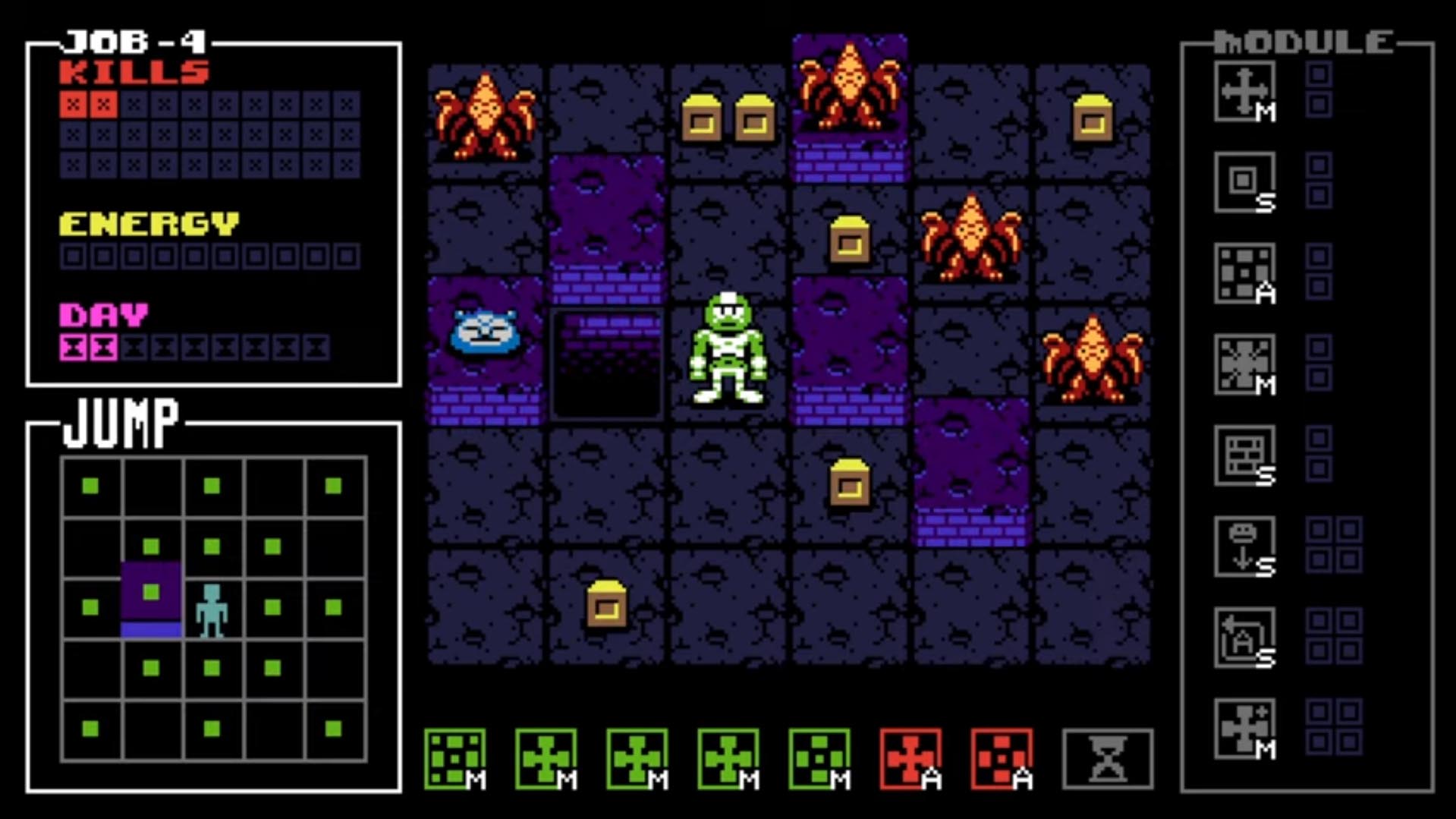
One thing I thought a lot about while playing the collection is how goal setting alone can push a player to dive deeper into the mechanics of a game. With Bug Hunter, a turn-based tactical game that tasks the player to eliminate a hoard of alien bugs within a set number of turns, I didn’t fully explore or understand every aspect of gameplay until I attempted the game’s highest achievement, surviving six back-to-back encounters without a loss. Early on, I could survive one or two rounds but would frequently reach a fail state when, from my point of view, I would face up against an impossible group of bugs or fail to get the right modules (the player has a set hand of seven modules at the bottom of the screen which they can switch out/upgrade from a “shop” of random available modules on the right side of the screen).
What I realized soon enough was that I had a preferred playstyle that limited how I approached the game, in turn limiting what I could achieve. When I had a comfortable scenario with modules that matched my desired playstyle, I would enjoy a smooth success, eradicating the alien bugs with ease, but when I was dealt a bad hand, the game felt obtuse and relentless. From here, I went online to research the game, to read what other players were saying, to fully understand the mechanics from each angle. I’d missed so much, but after some time I became very good at Bug Hunter and eventually received the highest achievement in the game, appreciating the long trip it took me to get there. Not every game in the collection is that difficult, but I did get used to this familiar cycle: fail, learn, succeed.
What I realized soon enough was that I had a preferred playstyle that limited how I approached the game, in turn limiting what I could achieve. When I had a comfortable scenario with modules that matched my desired playstyle, I would enjoy a smooth success, eradicating the alien bugs with ease, but when I was dealt a bad hand, the game felt obtuse and relentless. From here, I went online to research the game, to read what other players were saying, to fully understand the mechanics from each angle. I’d missed so much, but after some time I became very good at Bug Hunter and eventually received the highest achievement in the game, appreciating the long trip it took me to get there. Not every game in the collection is that difficult, but I did get used to this familiar cycle: fail, learn, succeed.
I could dedicate a monthly newsletter just about this 50-game collection alone but here’s a highlight of just a few memorable moments from the past year…
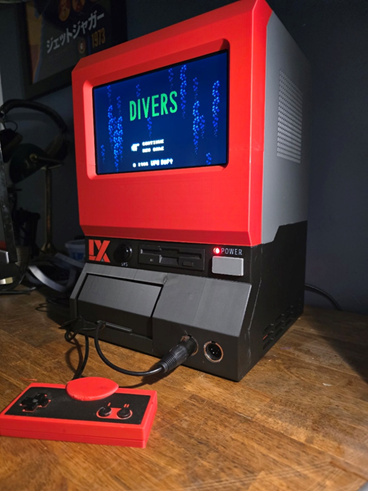
Within a month of the games release, X user LukeTheMaker posted a build of a real, functional 3D-printed LX system (the fictional game console within the world of UFO 50), along with offering 3D files encouraging others to build their own as well. An example of the creative and dedicated fanbase that formed around the game even early on.
Eirik Suhrke, one of the game’s developers, wrote hundreds of unique tracks for the game all within the limitations of the fictional LX system. My favorite in the collection is the playful and strange song Forest A from the game Mooncat.
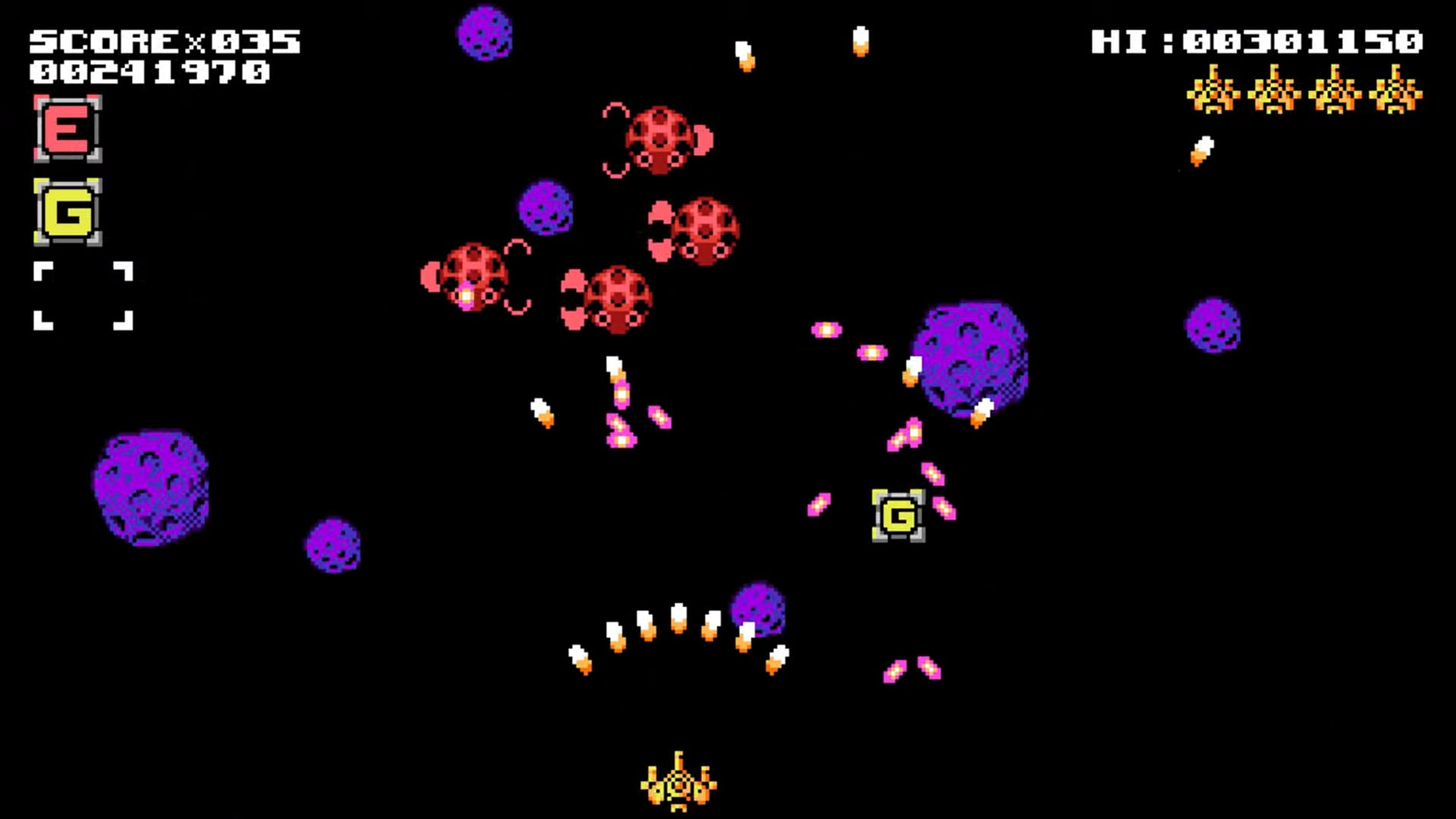
I wasn’t initially sure if I could beat Star Waspir, a lightning-fast shmup (short for ‘shoot ‘em up’ — these games are defined by shooting a barrage of enemies and dodging their attacks, like the overly caffeinated descendants of Space Invaders and Galaga) that is notoriously the most difficult game in the collection, but with loving support and helpful tips from the community discord, I actually did it! The game is about 10 minutes from start to finish if you play it perfectly, but it took me 18 hours over the course of three weeks to master. Beating Star Waspir with a score of 300,000+ felt less like beating a game and more like successfully performing an exorcism.
My wife and I met comedian Adam Conover after attending one of his shows in Providence, RI, this winter. He’s a frequent guest and member of the Eggplant discord channel, so I felt comfortable striking up a conversation with him about the game. To my surprise he brought the interaction up on the podcast! The anecdote starts around the 8 minute mark on the Mini & Max episode.
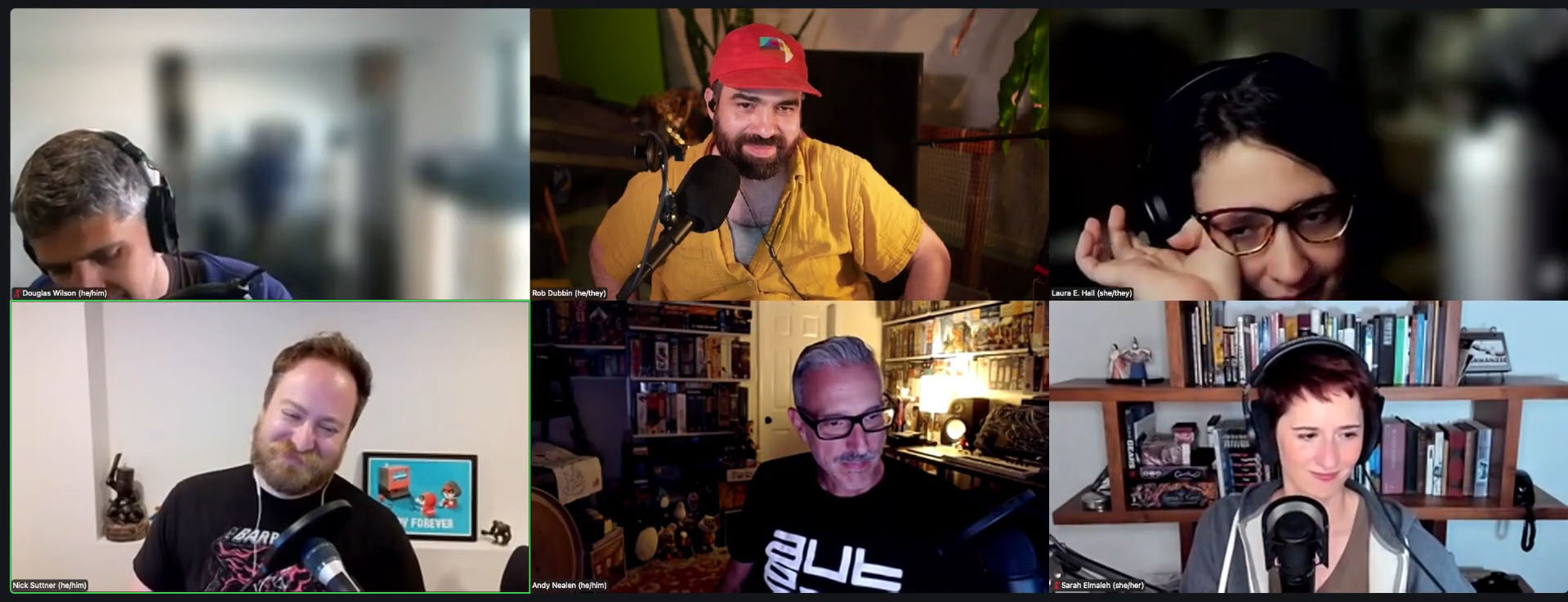
Top row (left to right): Doug Wilson, Rob Dubbin, Laura E. Hall
Bottom row (left to right): Nick Suttner, Andy Nealen, Sarah Elmaleh
Bottom row (left to right): Nick Suttner, Andy Nealen, Sarah Elmaleh
Joining to watch the four-hour live stream of the Eggplant podcast as they capped off the year was such a wonderful and bittersweet experience. The hosts and guests really made it a memorable night. It felt sad in the same way as the last day of the school year does when you’re a kid.
In Yu’s book Spelunky, a book he wrote about his development of the game Spelunky, he recalls early memories from his childhood discovering his parents’ game collection:
My first real roguelike experience was with one of its spiritual sequels called Hack, a genuine treasure hidden within the many 5.25-inch floppy disks that my parents acquired in graduate school before I was born. The disks themselves were treasures, too — poorly labeled with no apparent rhyme or reason to their organization, they were arcane to my young mind. Looking for computer games amidst the various school documents was like exploring a dungeon or brushing away dirt from a fossil, and I rifled through the disks many times, hoping to find something I missed.
It helped that the filenames gave little to no indication as to what the games were about. “HACK.EXE” conjures up images of hacking software rather than a roguelike…What the games and the disks elicited was a real feeling of mystery and excitement that is hard to come by in the era of online trailers, reviews, maps, and walkthroughs.
It helped that the filenames gave little to no indication as to what the games were about. “HACK.EXE” conjures up images of hacking software rather than a roguelike…What the games and the disks elicited was a real feeling of mystery and excitement that is hard to come by in the era of online trailers, reviews, maps, and walkthroughs.
This is where UFO 50 shines as more than the sum of its parts. From the very start, I loved this sense of discovery and curiosity the game invoked. I frequently booted up a game with a name that didn’t help me understand what type of experience I’d have (Rakshasa, Elfazar's Hat, Vainger, to name a few), and only after dying a few times would I even understand the genre of game I was dealing with. The discovery didn’t stop there. Many games did not reveal their true complexities until after digging much deeper, trusting that the developers had served up a well-sourced and thoughtfully cooked meal. And even then, there are even deeper secrets the collection had to offer that I didn’t discover until I had spent literally hundreds of hours with the collection.
I hope you enjoyed this deep dive into this unique little game. If anything, let it be a reminder that artists and communities can build some beautiful things.
I’ll have some more substantial Sad Land updates next month! I’m taking some time off from my day job later this week to clear my calendar, escape the city, and focus solely on game development to really push this thing forward.
Sincerely,
Neil
I’ll have some more substantial Sad Land updates next month! I’m taking some time off from my day job later this week to clear my calendar, escape the city, and focus solely on game development to really push this thing forward.
Sincerely,
Neil