Originally published on February 28, 2026

This month has been a great month of development with several updates. To recap, in October I began work on a new prologue area that will function as the game’s demo. You will play as Slime, a small slime creature, waking up in a dream world with four distinct areas to explore, each with its own theming. Last month I completed my first pass of the main hub of this dream world as well as one of the four areas: the graveyard. This month, I completed the first pass of two more areas: the castle and the coast.
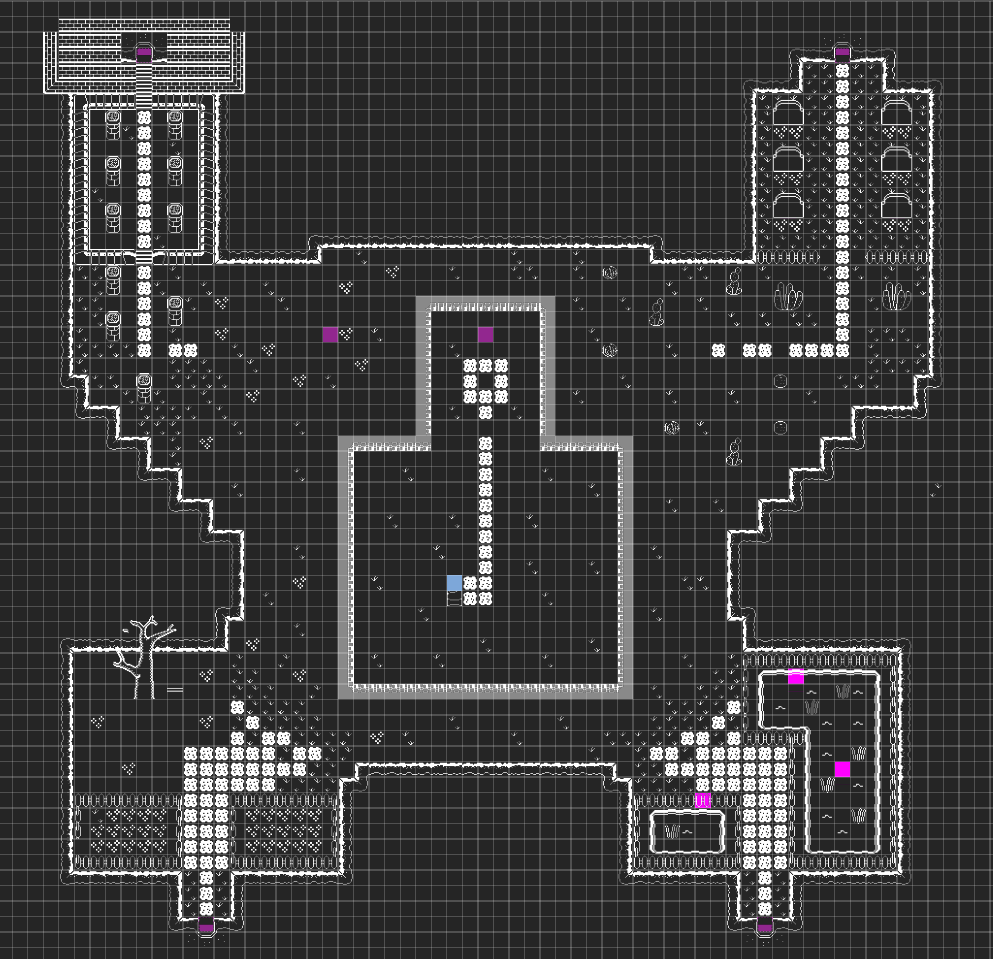
A working version of the hub map. Each corner of this large room has an entrance to a different area: castle (top-left), graveyard (top-right), beach/coast (bottom-right), and forest (bottom-left).
The first pass for these areas includes laying out the landscape and interconnected rooms with preexisting sprite work. I’m holding off on creating any new art assets and finalizing music until the entire build is playable in its unpolished state.
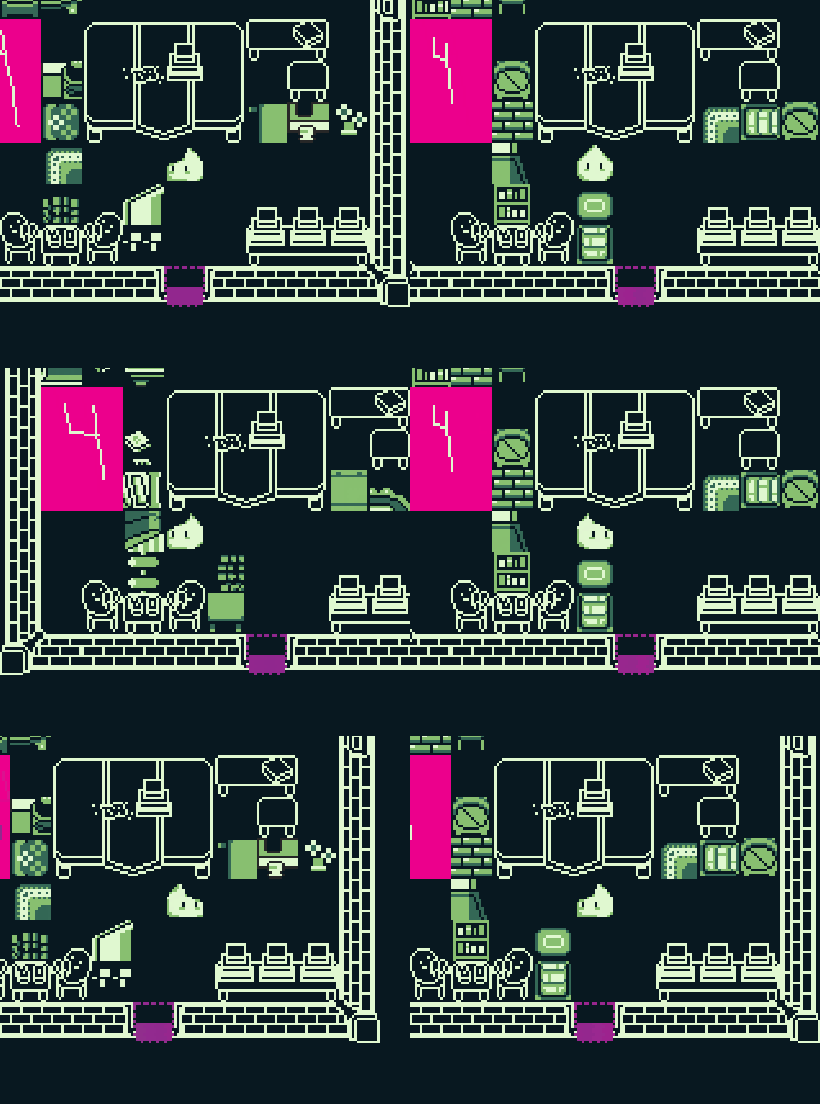
For the castle area, the player will navigate a dream version of the castle in which glitched sprite objects will block their path. Interacting with NPCs shifts those glitched sprite objects around, allowing the player to progress. I created a few glitched objects for this area as a proof of concept (pictured above) but am leaving a lot of these assets as colorful numbered placeholders for the time being. Once I coded how these objects move based on player interactions, it was a straightforward process to lay them out in the remaining rooms of the dream castle.
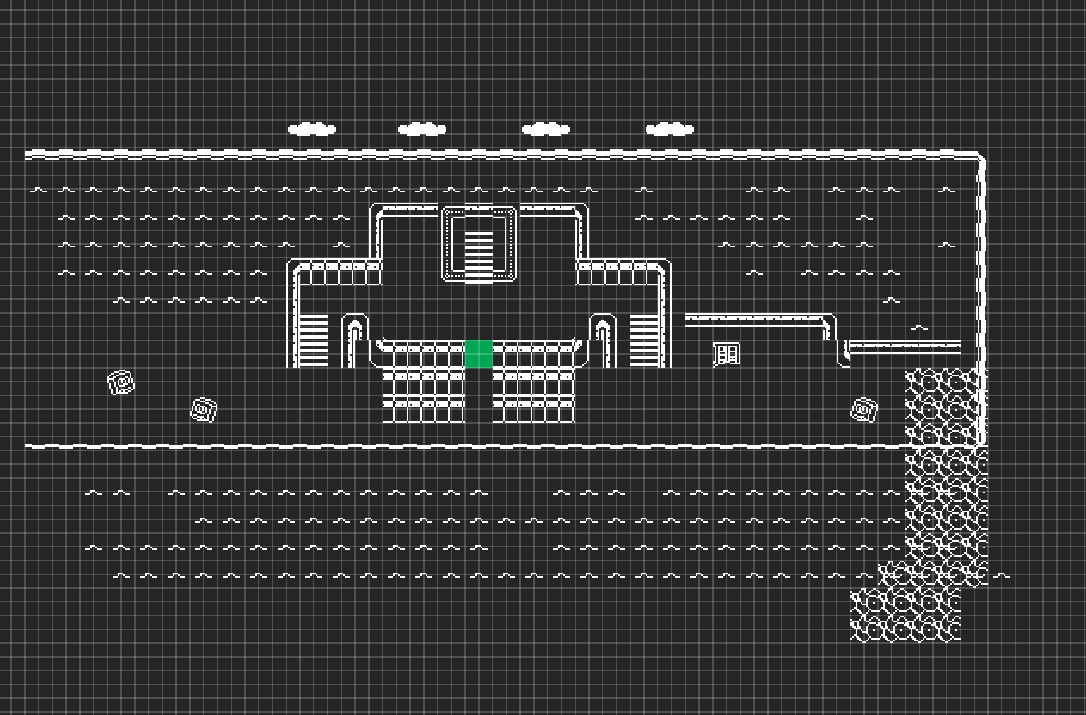
If the player ventures off into the bottom-right corner of the hub room, they’ll wind up at this beach where there is a puzzle to solve. This area went through several iterations until I landed on a layout that worked for the interaction (I needed the beach at the bottom of the area, the ocean and the horizon at the top, and a structure at the center). Since I’m playing fast and loose with the art assets until I have a fully playable alpha build (incomplete art with bugs, but playable), this area isn’t pretty but shows my intentions for the final layout.
At the top-center of this beach map is an interactable pedestal that allows the player to insert a combination based on some clues found on the beach.
At the top-center of this beach map is an interactable pedestal that allows the player to insert a combination based on some clues found on the beach.
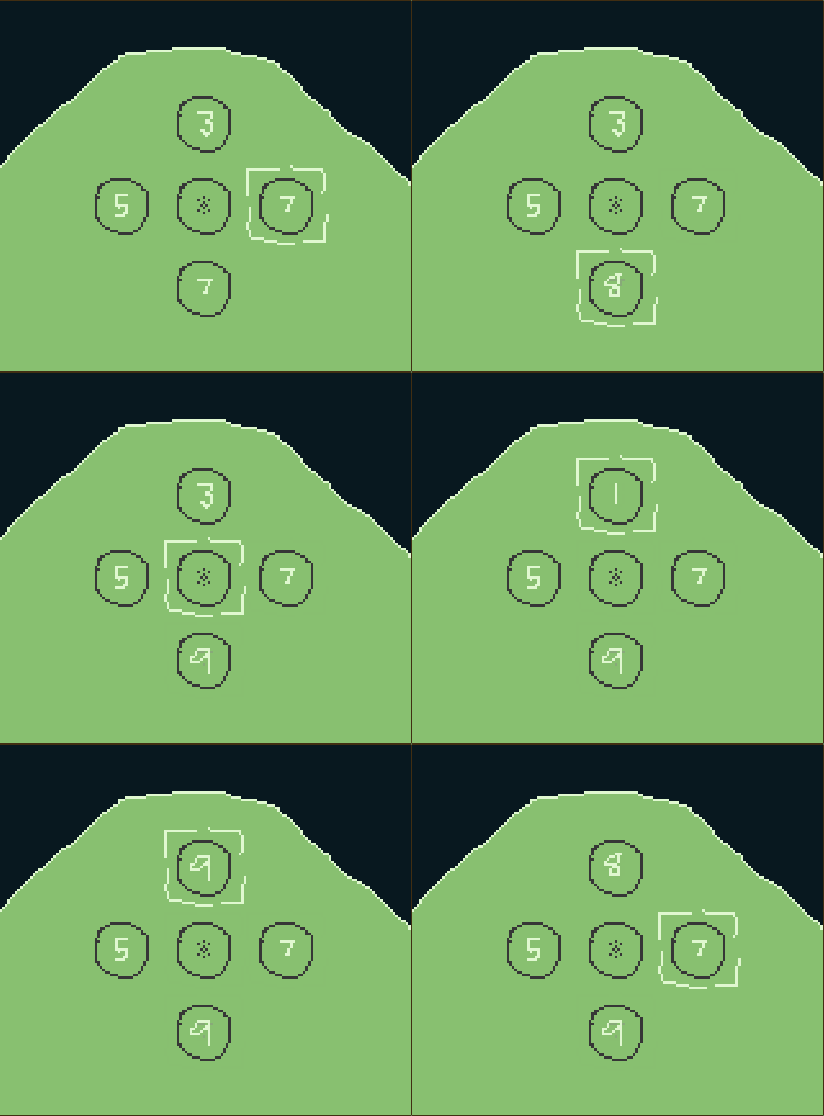
The prototype for this screen is functionally complete but will be getting a massive graphical overhaul when the time comes. For testing purposes, I’m using numbers for the input but plan to replace them with pictorial symbols in the final product. Getting both the castle and the beach fleshed out this month has made me excited at the prospect of building out the final area, the forest, and from there I will move on to playtesting and punching up all the visuals and adding music.
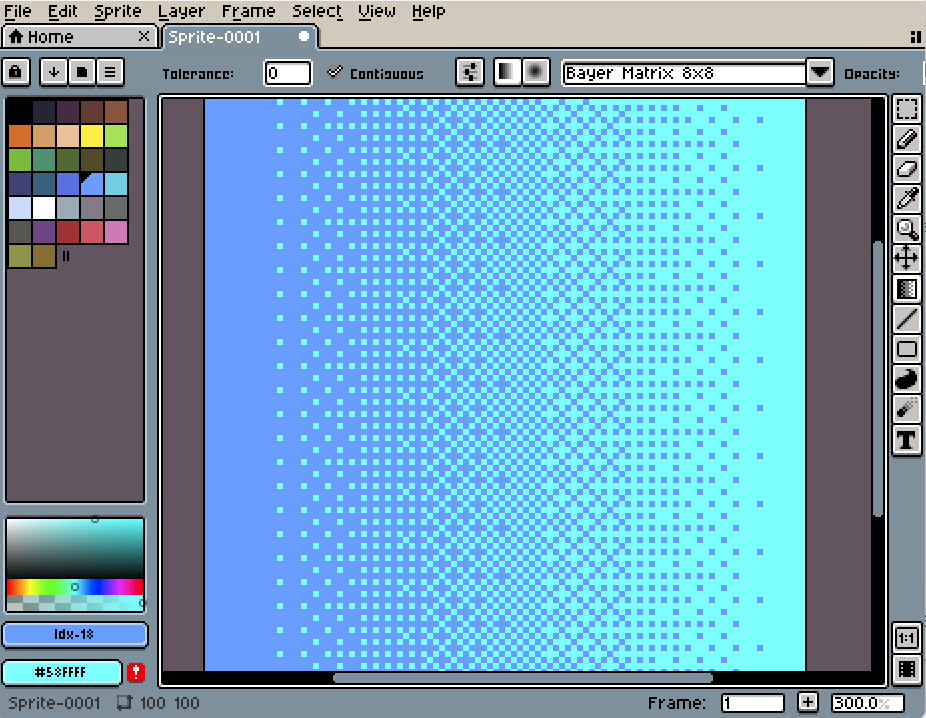
Although I haven’t been focusing all that much on pixel art, I did recently purchase Aseprite, an inexpensive program that is explicitly designed for making pixel art for video games. Since switching over, I’ve followed several different tutorials on how to use all the features Aseprite has to offer, putting me in a good place to more easily and quickly make art assets for my game. As the program is tailored to game developers, I can already see how I’ll be able to simplify my workflow on this project and all sprite-based projects moving forward.
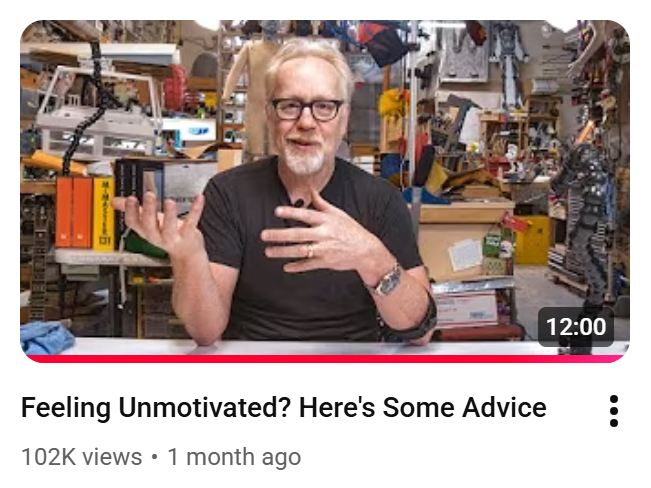
Between picking up Aseprite as a new tool in my arsenal and reading Adam Savage’s Every Tool’s A Hammer: Life Is What You Make It, I’ve been thinking a whole lot about my relationship with the tools I use. Savage is best known for his long-running television show MythBusters and his years working on props and special effects for big blockbuster films. After shooting nearly 300 episodes of MythBusters, Savage switched his focus over to producing maker and technology content for his YouTube channel Tested (the company was started by Will Smith [probably not the Will Smith you’re thinking of] and Norman Chan in 2010 and was later acquired by Savage). The channel has tons of fantastic content relating to film props and workshop builds, but I’ve found the most valuable uploads to be the short Q&As posted with Savage giving advice and shedding light on his journey as a life-long creator. Savage shows compassion, kindness, and thoughtfulness as he leverages his decades of collaborations, successes, failures, and hands-on learning to share insight on the creative process. And his book is no different.
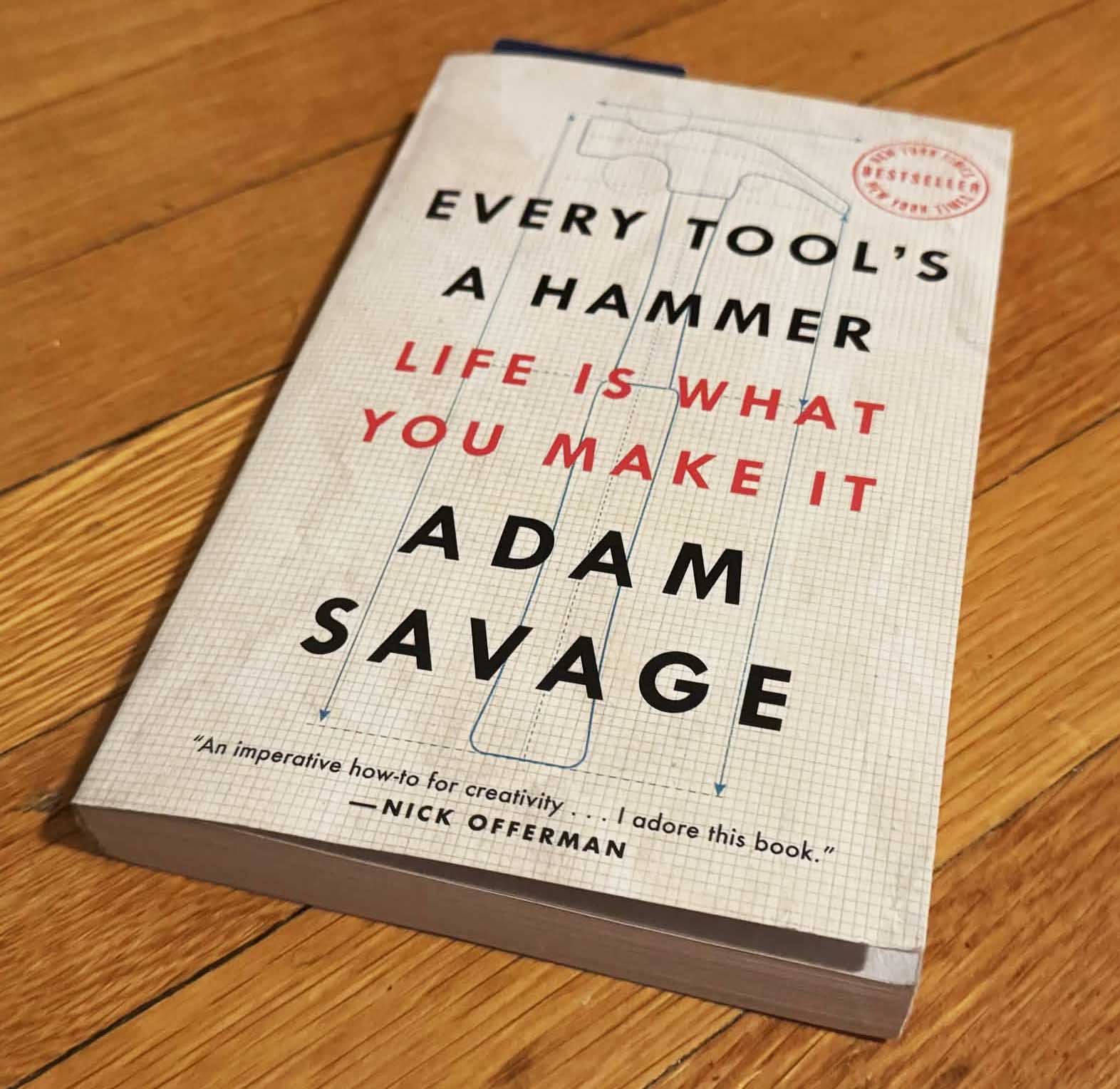
At the core of Savage’s writing is a deep love for creation and sharing that work with others, whether that means collaborating with other professionals on commercial work or walking around Comic Con in a bear costume. Although it’s not all good vibes. Early on, he shares an excruciating story from very early in his career where he overpromised and underdelivered on the set design for a friend’s independent short film, putting the entire project in jeopardy and losing the friendship as a result. Not all learning experiences are fun, but what he learned from that debacle and being open to criticism and advice proved to help him become who he is today.
One of my favorite quotes from the book is about the physical relationship one has with their tools: “Doing puts the kind of knowledge in your body that can only be gained through an iterative process.” It’s good to be reminded that muscle memory and the act of using a tool over and over builds a familiarity that allows for quick iteration, prototyping, and creation. Sitting down at the piano more makes it easier for me to write music, coding in Game Maker every week makes it that much easier to build out functional systems in my game, writing these newsletters every month makes it easier to express my ideas, and the list goes on and on.
The book is chock full of practical guidance, but I wanted to share this passage that felt all too relevant to my years-long journey developing Sad Land. Here Savage writes on the importance of exploring ideas on paper:
One of my favorite quotes from the book is about the physical relationship one has with their tools: “Doing puts the kind of knowledge in your body that can only be gained through an iterative process.” It’s good to be reminded that muscle memory and the act of using a tool over and over builds a familiarity that allows for quick iteration, prototyping, and creation. Sitting down at the piano more makes it easier for me to write music, coding in Game Maker every week makes it that much easier to build out functional systems in my game, writing these newsletters every month makes it easier to express my ideas, and the list goes on and on.
The book is chock full of practical guidance, but I wanted to share this passage that felt all too relevant to my years-long journey developing Sad Land. Here Savage writes on the importance of exploring ideas on paper:
With so many individual components, so many different materials and methods, so much that has to fit together just right, in just the right order, the more complex a project the more likely it will be to confound you at some point in the process. You can’t make this part until that part is finished. You can’t assemble these pieces until that one is painted. When you have forty parts to make for a build, it’s easy to spend a precious day building something wrong, and man it’s hard to work up the energy to build that again. Drawing, in those moments, has helped me fight off that momentum killer because it invariably increases my understanding of the physical totality of the thing I’m working on. My initial renderings—the drawings that translate the original idea from the brain – help me realize the object I’m creating at a macro level. Drawing as a method to crack through complexity, on the other hand, is to zoom in on the object and get familiar with it at all of its micro levels. Inevitably, the new familiarity that drawing produces is what unlocks the part of the puzzle that has kept me stuck, and provided the movement I need to get the ball rolling again.
Savage is my go-to maker for advice and wisdom, but when it comes to actually making a build, I often turn to the content of Simone Giertz.
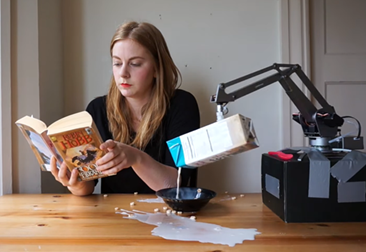
I was first introduced to Simone Giertz (pronounced “Yetch”) just over ten years ago after she went viral online for showcasing her homemade robot projects. The series of videos she posted, dubbed “shitty robots,” were perfectly tailored to gather attention in the internet of 2015; they were short (straight to the point and easy to recommend), impressive (any robot, even a shitty one takes a lot of effort), and had a quick and satisfying comedic payoff (the robots stumble through the one task they were built for with Giertz nearby, perfectly deadpan). Her Breakfast Machine technically does get cereal and milk in the bowl before it offers Giertz a spoon to eat it with but makes a complete mess doing so.
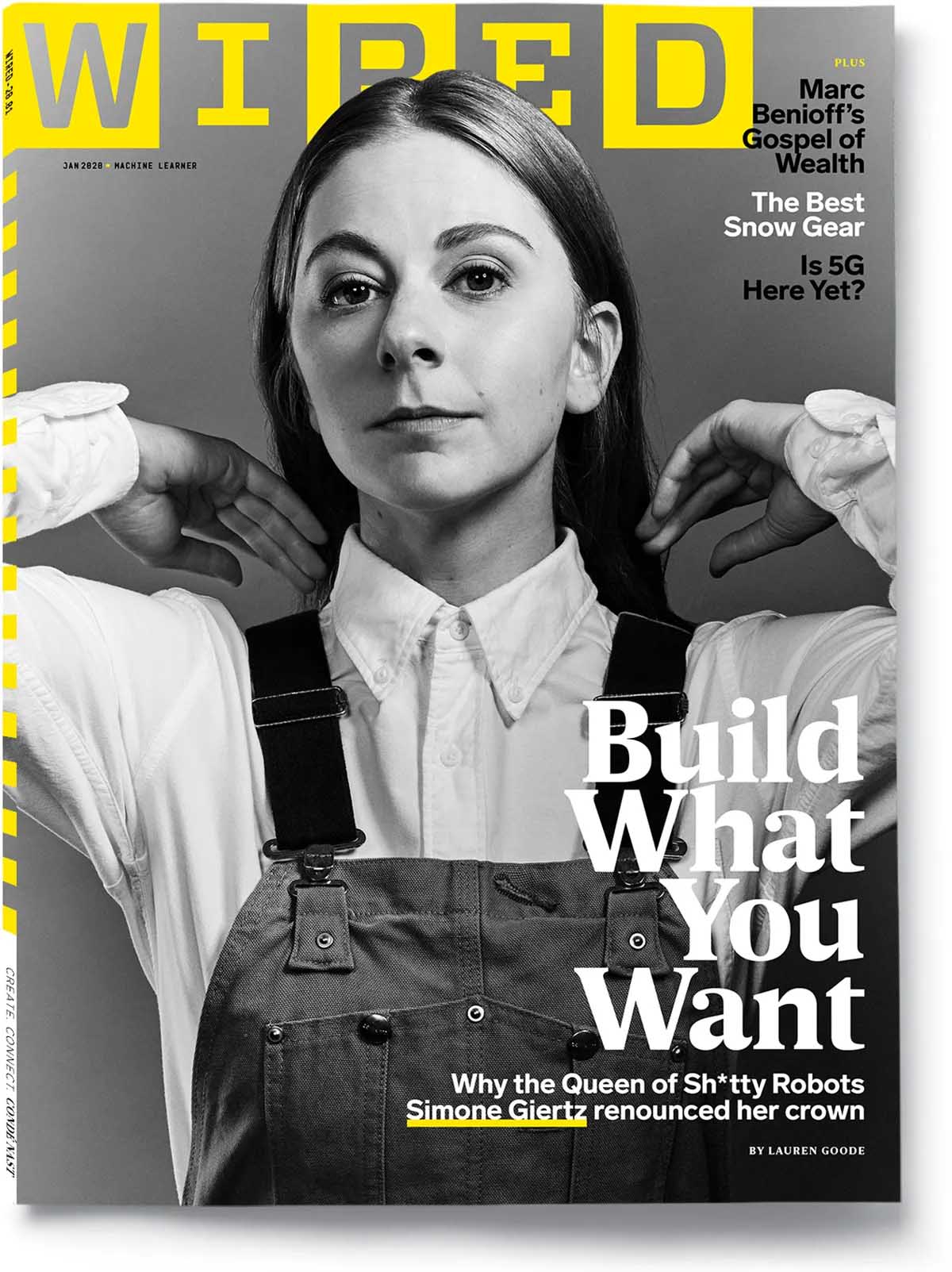
Four years after coming across her viral videos, I find that she’s not only featured in the January 2020 issue of Wired magazine, but hers is the cover story (Build What You Want: Why the 'Queen of Shitty Robots' Renounced Her Crown). I learned Giertz had moved on from shitty robots, moved to America (originally from Stockholm, Sweden), survived the removal of a golf-ball-sized brain tumor, and converted her Tesla into a pickup truck. I went back to reread this article as research for this newsletter and hadn’t realized that Adam Savage began a working relationship with Giertz shortly after her shitty robots were making the rounds online. Giertz was a collaborator and contributor to Tested for several years before she fully committed to her own YouTube channel.
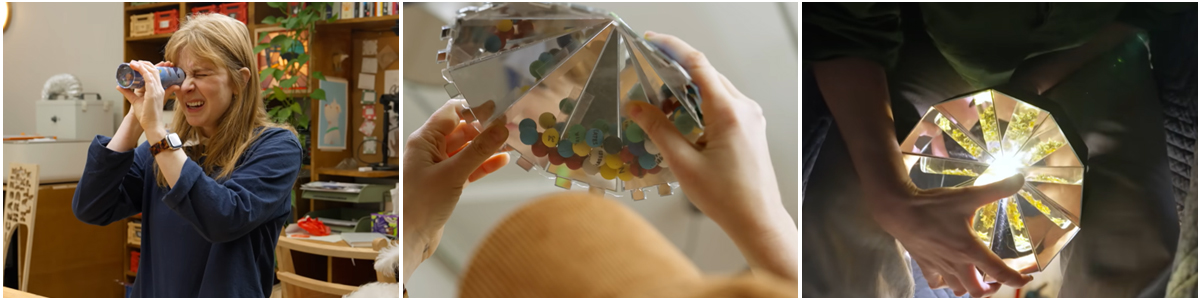
Her most recent video (This lamp changes every time you look at it) exemplifies what I love so much about the work she does as a creator. Within just under 17 minutes, we follow Giertz through every stage of a build, from inspiration to final product. First, she shares the initial concept: what if a kaleidoscope was a lamp? This concept leads to the ideation stage where she talks through what she hopes to accomplish and how it could potentially function. From there we see several experiments, rough prototypes that give her idea of what works and what doesn’t.
Her most recent video (This lamp changes every time you look at it) exemplifies what I love so much about the work she does as a creator. Within just under 17 minutes, we follow Giertz through every stage of a build, from inspiration to final product. First, she shares the initial concept: what if a kaleidoscope was a lamp? This concept leads to the ideation stage where she talks through what she hopes to accomplish and how it could potentially function. From there we see several experiments, rough prototypes that give her idea of what works and what doesn’t.
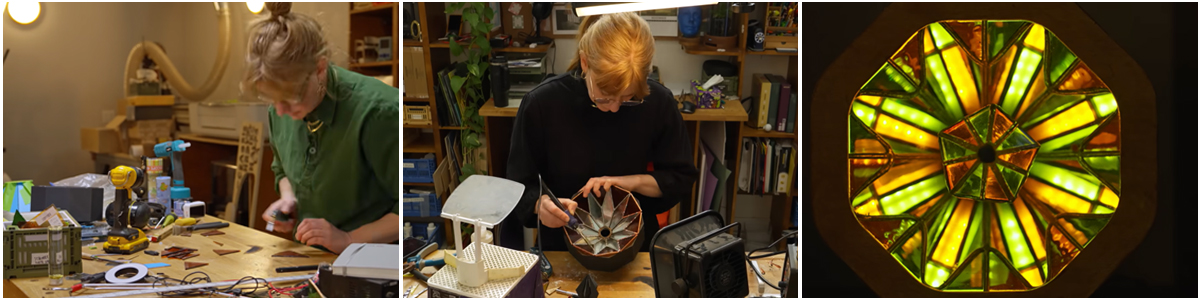
Little by little, the lamp starts to come together, and you get to see the kaleidoscope lamp take shape. From taping together pieces of glass to soldering together a beautiful decorative piece, we get to see the payoff of her hard work and skillful problem solving. And this is just the most recent example of this. If you go to her channel, you will find so many other videos like this where she invites you into her workshop to walk you through another fascinating one-of-a-kind project. Giertz is currently gearing up to launch a Kickstarter campaign, a chair with a rotating rail that you can hang your clothes on.
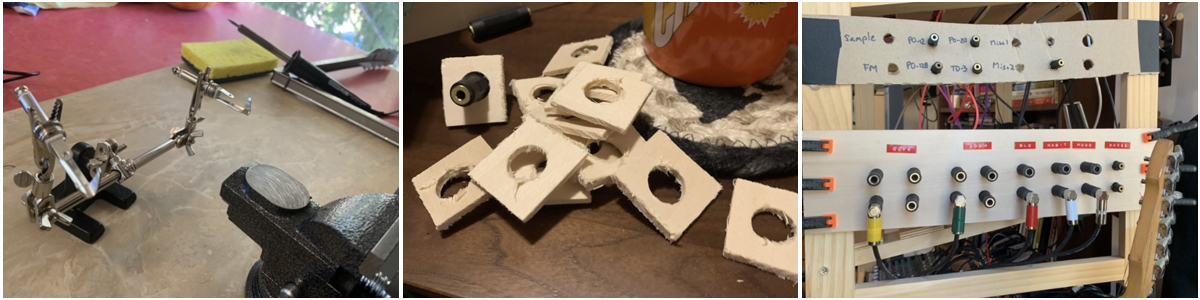
Outside of game development, I have this ongoing project I’ve been working on for years now. Back in 2020, I started building out a collection of music sequencers and guitar pedals. Setting up all the equipment every time I wanted to experiment with them became cumbersome, inspiring me to start ideating on a permanent workstation for them to live along with a way to handle all the signals. After months of searching for the right shelving unit, I purchased a wooden rack online meant for storing bread in convenience stores (I now refer to my workstation as “The Bread Rack”). From there I taught myself to solder so I could make my own cables and did some minor woodworking to create the panels for input/output management.
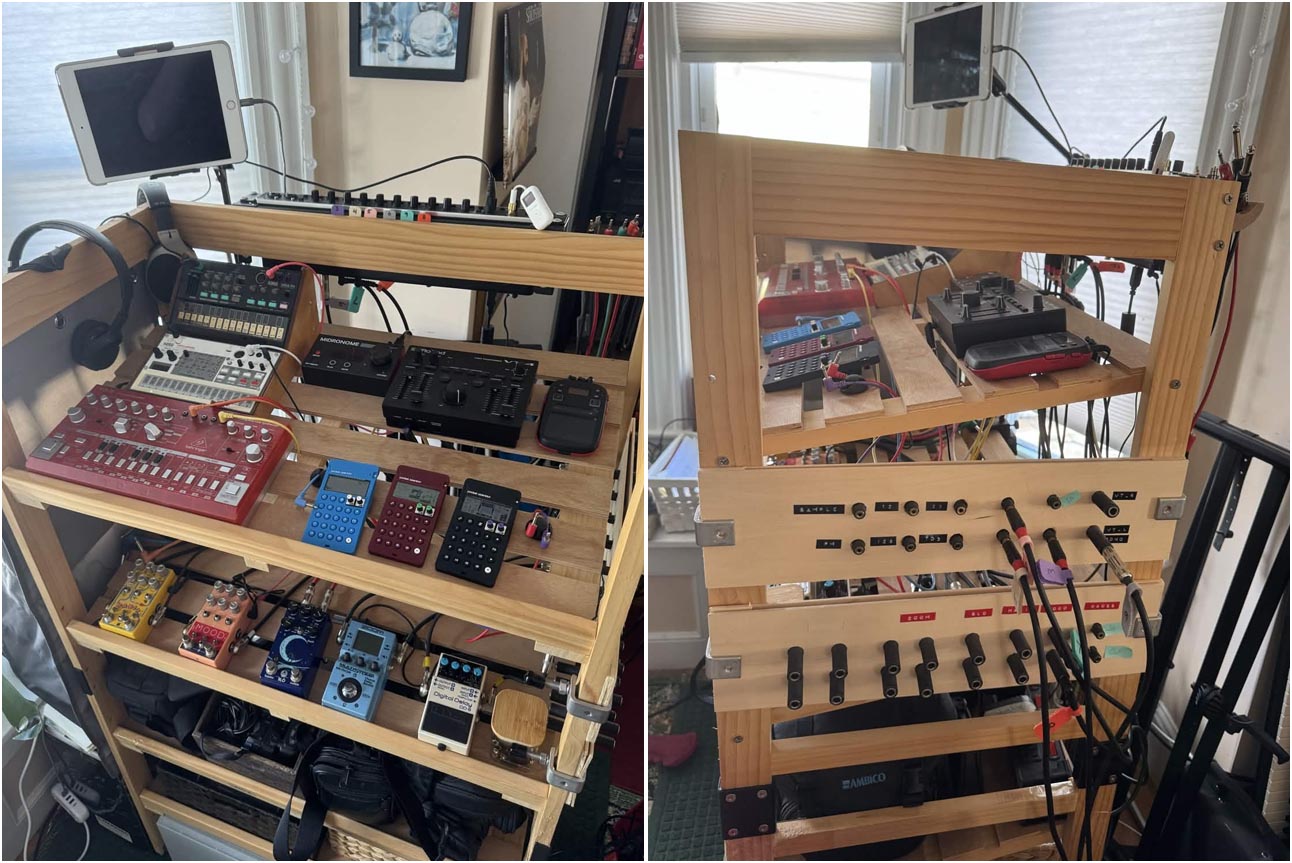
Just this month I added the last few cables that, at least for now, bring the project to its final form. Most everything is capable of synchronizing with a primary midi clock and all individual audio outputs funnel into one audio interface that separates each signal as its own audio track. I’ve experimented this this equipment a lot over the years and am looking forward to digging even deeper into what strange effects chains and sound experiments I can come up with through this unusual monstrosity.
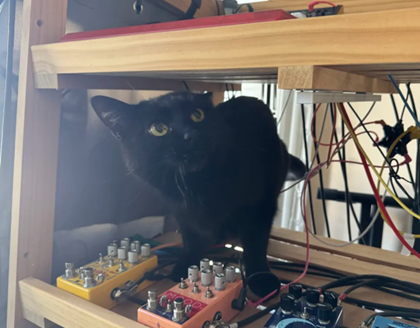
As I was writing this, my cat jumped on the pedal shelf. Evidence of his crimes.
To end this month’s rumination on tools, I wanted to share some insight from YouTuber and all around creative internet guy Hank Green from a video he put out last year called Don’t Follow Your Dreams, Follow Your Tools:
In among your tools includes you, includes your values, includes what inspires you, includes what you know, what you’ve learned about, what you’ve been drawn toward, what excites you, what you believe in. All that stuff is part of your toolkit.
I really honestly think that at the core of what has helped make me successful is that I don’t have dreams, I don’t want to do anything in particular and that allows me to do two things. Number one: just look at my toolkit - which includes me and includes what I want and includes, like, the things I’m curious about and my values – I’ll just look at my toolkit and think, “what can I do with this?”
So every time I take my toolkit and I say, “okay, I could do this,” it turns out my toolkit was not complete enough to actually do that thing. I had to learn a bunch of other stuff along the way.
I really honestly think that at the core of what has helped make me successful is that I don’t have dreams, I don’t want to do anything in particular and that allows me to do two things. Number one: just look at my toolkit - which includes me and includes what I want and includes, like, the things I’m curious about and my values – I’ll just look at my toolkit and think, “what can I do with this?”
So every time I take my toolkit and I say, “okay, I could do this,” it turns out my toolkit was not complete enough to actually do that thing. I had to learn a bunch of other stuff along the way.
Next month I plan to at least complete a working build of the area, meaning I’ll at long last have an alpha build to test, polish, and eventually share. My goal to release the demo within Q1 is not going to happen, but I do feel more confident and closer to a release than I’ve ever felt in the project. Next weekend I’ll be flying out to San Francisco to attend GDC for the first time! Excited to report back in next month’s newsletter.
Sincerely,
Neil
Sincerely,
Neil