Originally published on March 31, 2025
Last month I took a trip down to Orlando with a few friends to visit Disney World. Although I’d been to Disneyland before, it pales in comparison to the sheer volume of attractions and resorts that make up the expanse that is Disney World. The roughly 43-square-mile complex operates under its own government and was opened back in 1971, five years after Walt Disney died of lung cancer. Before it was an extravagant tourist destination, the area was mostly undeveloped swampland. Using dummy corporations, Walt secretly purchased the land plot by plot, knowing full well that if the landowners knew who he was and what he was planning, they would have asked for more money.
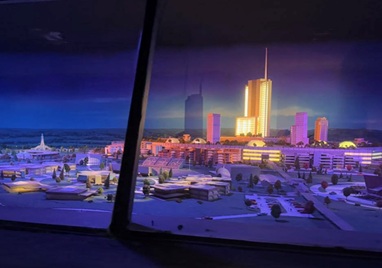
A model of Progress City, Walt’s concept for a futuristic city, as seen from Tomorrowland’s People Mover. Although they never built the city as Walt envisioned, it did inspire EPCOT (Experimental Prototype Community of Tomorrow)
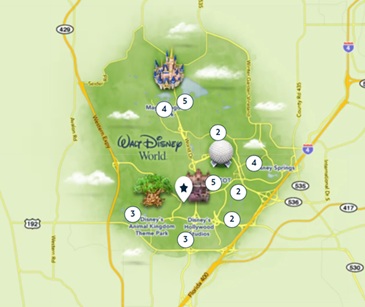
What struck me again and again during my trip was the use of each park’s symbolic structures, sometimes referred to as “Icons.” There are four parks that make up Disney World, and each park has one colossal building that can symbolically represent that park. You can see this in action over on the Disney World website, where if you zoom out, the intricate park maps are replaced by small images of these buildings…
This concept isn’t unique to Disney World; many cities have iconic structures that act as a shorthand for the city itself. Paris has the Eiffel Tower, Sydney has the Sydney Opera House, and Rio de Janeiro has Christ the Redeemer. Those structures, however, were built long after those cities were developed. Disney’s icons, with the exception of Hollywood Studios (I’ll dive into this further on), were baked into the parks design from the very beginning.
In his book Designing Disney (with co-author Peggy Van Pelt) John Hench, an artist, director, and imagineer with a career spanning over six decades, sheds light on the design philosophy of these icons…
In his book Designing Disney (with co-author Peggy Van Pelt) John Hench, an artist, director, and imagineer with a career spanning over six decades, sheds light on the design philosophy of these icons…
Walt observed that people move toward things that are inviting, and he coined the term wienie to refer to such things (Walt had a lifelong love of hot dogs). Imagineers have found that people respond to a wienie at the end of a corridor because it beckons them to continue further in their journey. We often use archetypal forms in designing a wienie, forms that have centuries-old associations that express some kind of action. Certain sharp-edged, pointed forms suggest danger, adventure, a struggle for survival. Rounded forms tend to be reassuring, suggesting shelter, safety, and fun. I’m telling a story in three-dimensional visual terms, both kinds of forms can be used to say, ‘Something is happening down this way, and you’re going to like it.’ The wienie promises that you will be rewarded for the time and effort it takes to walk down that corridor. A well-designed wienie can brighten and energize and entire area.
Before visiting Disney World, I hadn’t given much thought to their giant wienies, but while inhabiting the space, I couldn’t help but marvel at how many different ways they function in the park beyond just being a neat thing in the distance.
For this month’s newsletter, I’ll be focusing on these icons, before I switch gears next month to explore how this design philosophy extends to video games and their environmental design.
For this month’s newsletter, I’ll be focusing on these icons, before I switch gears next month to explore how this design philosophy extends to video games and their environmental design.
Cinderella’s Castle (Magic Kingdom)
Based off the castle from the animated film Cinderella, drawing inspiration from an array of historic European castles, Cinderella’s Castle is the central wienie of the Magic Kingdom and the definitive icon of Disney World itself. After entering the park, you are funneled into Main Street, U.S.A., where you get a view of the ornate landmark at a distance: a destination, a beacon, an invitation, a promise.
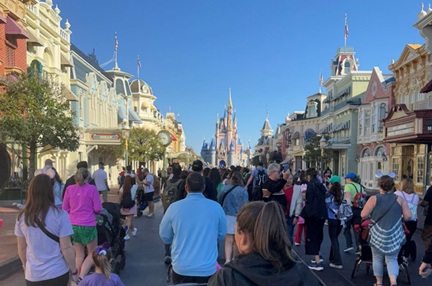
The view of Cinderella’s Castle from Main Street, U.S.A. I explored this topic in my September 2024 newsletter after visiting Disneyland last summer.
The castle acts as an entryway into Fantasyland but is also a destination housing several attractions. In front of the castle is a grand stage where mascots and entertainers put on shows throughout the day. Beyond that they have a shop (the Bibbidi Bobbidi Boutique), a restaurant (Cinderella's Royal Table), and at one time a deluxe suite (Cinderella Castle Suite).
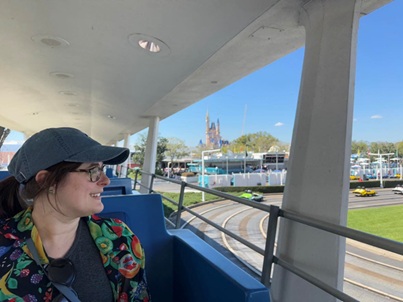
Designers used forced perspective to make the building appear taller than it actually is; the bottom level is full size while the towers (down to the brick detail and windows) narrow/shrink as they draw the eye toward the tips of the spires. Even considering this, the icon is still quite large and can often be seen from across the park. Jutting out from the horizon, it is a helpful marker that leads you back to the central hub and acts as an ever-present reminder that you are in the kingdom of magic.
The Tree of Life (Animal Kingdom)
Over in the Animal Kingdom, the intricately detailed Tree of Life serves as the central icon for the park. With a steel oil rig platform serving as the frame, this intricately etched structure based on the African baobab tree sits in the middle of the park.
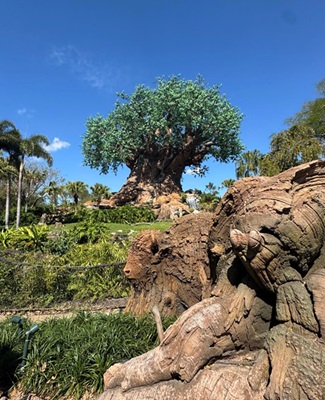
Unlike Cinderella’s castle and the other icons, the Tree of Life does not have any straight and direct paths to get up close to the tree.
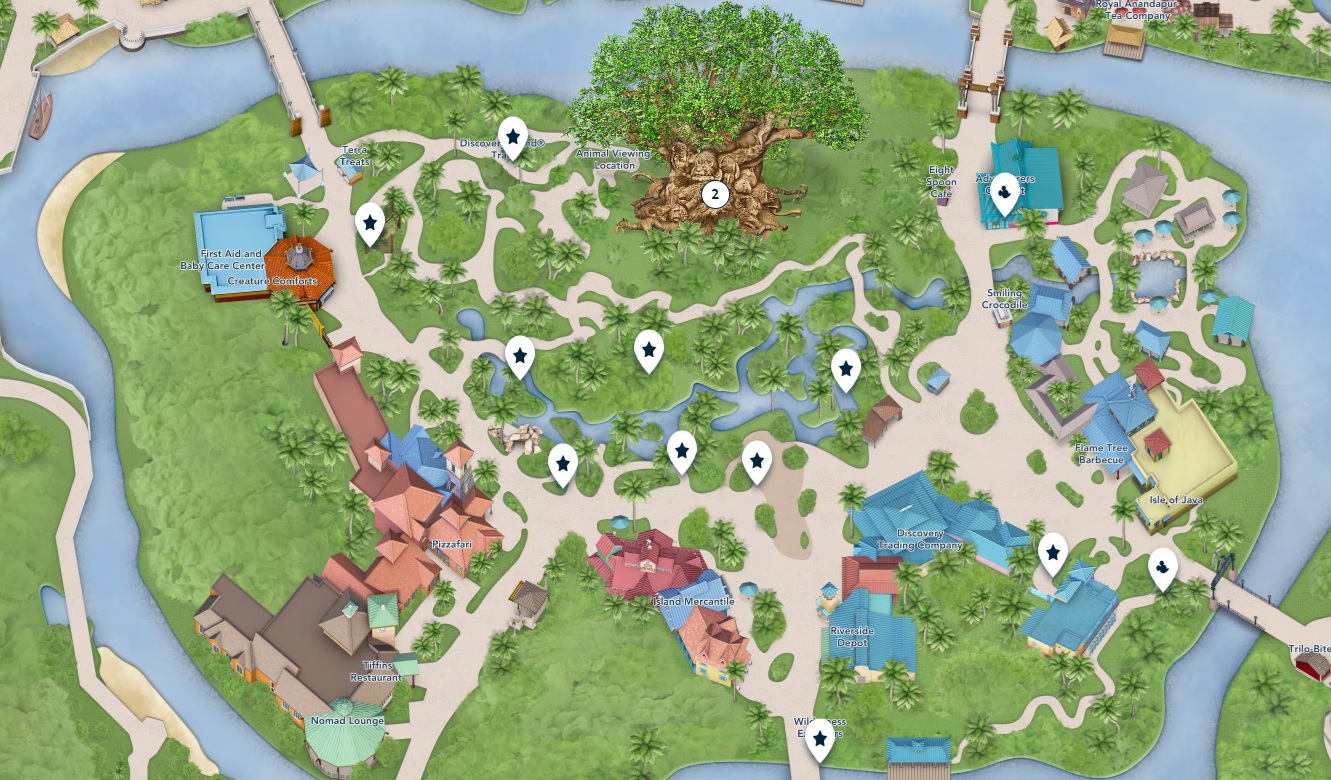
It is easy to get a clear view once you make it to Discovery Island, but the Discovery Island Trails themselves surround the tree in organic paths. Sticking to the theme of the park, nature and discovery, this area feels less like a manicured amusement park and more like older trails that the park was built around.

The tree of life does not contain an attraction within but underneath. If you follow the right trail, you’ll find yourself approaching the tree below ground level, until you reach the entrance to the hollowed-out enclosure accompanied by the tree’s enormous roots.
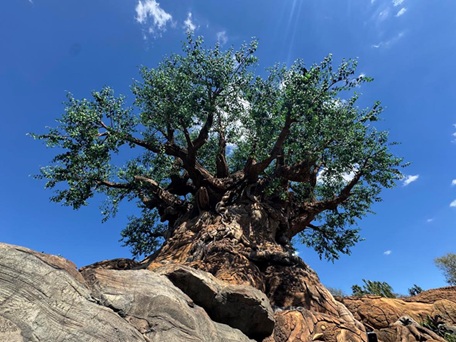
From that angle, looking up at the tree is quite a sight. With it looming just above, it’s fitting that the attraction underneath the tree is It’s Tough to be a Bug!, a 3D mixed-media show starring characters from Pixar’s A Bug’s Life. Usually, attractions based on films come out after a film is released but this one came out seven months before A Bug’s Life premiere back in 1998.

I’m glad I was able to see the show during my recent trip because just this month the attraction had its last showing on March 16th, ending its 27-year run to make way for a new Zootopia attraction.
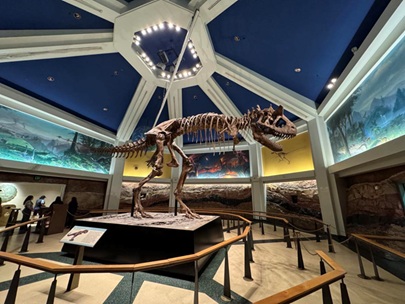
As a side note, one thing I was not expecting of the Animal Kingdom is that certain locations felt like visiting Jurassic Park sans live dinosaurs. That said, between Dinoland, U.S.A., and the Dinosaur ride (sadly both closing in 2026), there was no shortage of extinct pre-historic lizards!
Spaceship Earth (EPCOT)
The “big golf ball” that greets you when you enter Epcot is aesthetically the simplest icon and is more thematically up to interpretation. This geodesic sphere resembles the Buckminster Fuller-designed Biosphere built for the United States pavilion at the Montreal Expo 67 World's Fairs and was designed by the same Boston-based engineering firm. EPCOT functions as a sort of permanent World’s Fair, a celebration of technology, culture, and innovation.

Although the park may present an overly optimistic, whitewashed, and often nationalistic point of view (particularly the America and China pavilions), it was hard not to get caught up in everything this park had to offer. We spent two days, walking a total of twenty miles, exploring everything from Mission: Space to the Kawaii exhibit at the Japan pavilion.
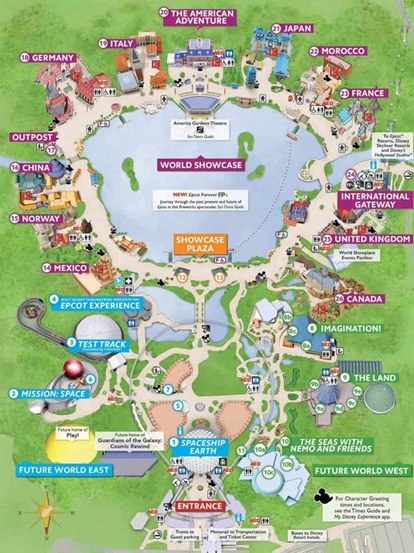
In contrast to the Animal Kingdom’s organic pathways, EPCOT’s design is geometric through and through. The courtyard surrounding the dome branches off to different buildings that house attractions, exhibits, and edutainment. The back half of the park is the World Showcase, a series of pavilions representing different countries from around the world. There is no shortage of great drinks and food, something that gives EPCOT it’s reputation as the “adult Disney park.” I bring this up here because the World Showcase Lagoon functions as the park’s secondary icon. It’s highly visible, helps you keep your bearings, and if you count the ride on the FriendShip boats from Canada to Morocco, it too contains an attraction.
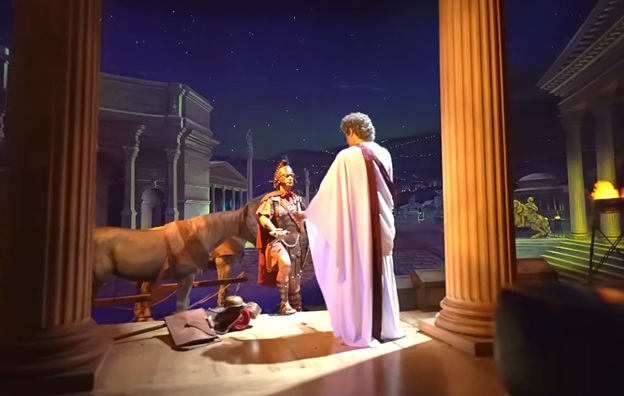
The Roman Empire as depicted in Spaceship Earth retrieved from Theme Park Shark’s full video of the attraction. This is where Judi Dench says that the network of roads built by the Romans was the first “World Wide Web.” It’s my favorite part.
Speaking of attractions, the giant sphere that is Spaceship Earth houses an excellent dark ride narrated by Judi Dench offering a glimpse into the history of innovation and communication by way of beautiful sets and detailed animatronics.
Before moving on, I’d like to recommend the 18-minute 1982 masterpiece that is Impressions De France showing at the Palais du Cinéma in the France pavilion. The French really know how to make a good film.
Before moving on, I’d like to recommend the 18-minute 1982 masterpiece that is Impressions De France showing at the Palais du Cinéma in the France pavilion. The French really know how to make a good film.
Tower of Terror (Hollywood Studios)
Disney’s Hollywood Studios houses the fourth and final icon: The Twilight Zone-themed Hollywood Tower Hotel, also known as the Tower of Terror.
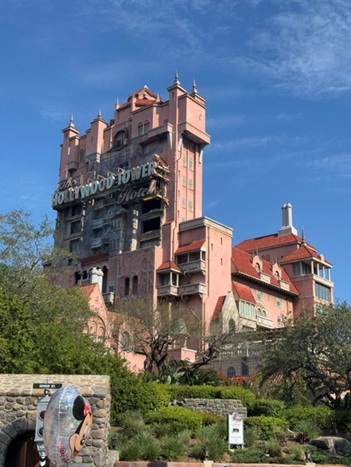
Made to look like a cobweb-ridden hotel last operating during the dawn of the Golden Age of Hollywood (circa 1930), the entrance leads you through a beautiful and atmospheric misty courtyard before you enter the lobby and, from there, The Twilight Zone. The ride itself is thrilling enough, freefalling and bounding back up within a “broken” elevator shaft, but the theming and special effects within the pre-show (directed by none other than Gremlins 2: The New Batch’s Joe Dante) make it extra special. It is the perfect melding of detail, ambiance, and tension that creates an unforgettable attraction that is simply some of the best Disney has to offer. The Art of Engineering YouTube channel has a great breakdown of how the tower functions that makes me appreciate it on a whole other level.
This attraction was not only one of the big reasons I wanted to visit Disney World in the first place as a lifelong The Twilight Zone fan, but it also inspired me to write this newsletter about Disney’s icons. You see, The Tower opened six years after Hollywood Studios (formerly Disney-MGM Studios), meaning the park wasn’t built with the Tower to be its main wienie.
This attraction was not only one of the big reasons I wanted to visit Disney World in the first place as a lifelong The Twilight Zone fan, but it also inspired me to write this newsletter about Disney’s icons. You see, The Tower opened six years after Hollywood Studios (formerly Disney-MGM Studios), meaning the park wasn’t built with the Tower to be its main wienie.
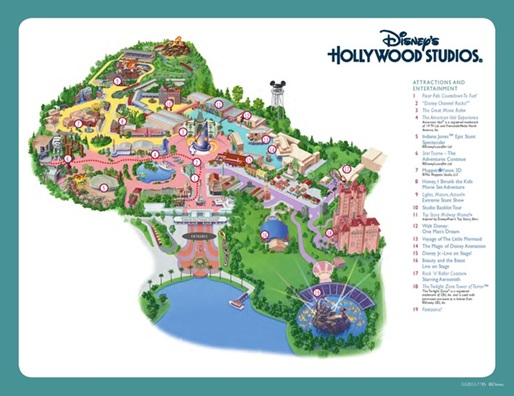
Map of Disney’s Hollywood Studios from 2008
Not only that, but the Tower also isn’t centrally located like the other icons. It sits tucked away at the end of Hollywood Boulevard, where it looms large at the edge of the park. So what is the history here? With the other icons so thoughtfully constructed and placed at the center of their respective parks, why is Hollywood’s Tower so radically different?
It turns out there were two other structures that functioned as Hollywood Studios icons before they constructed the Tower of Tower: the Earffel Tower and a full-scale recreation of downtown L.A.’s Grauman's Chinese Theatre.
It turns out there were two other structures that functioned as Hollywood Studios icons before they constructed the Tower of Tower: the Earffel Tower and a full-scale recreation of downtown L.A.’s Grauman's Chinese Theatre.
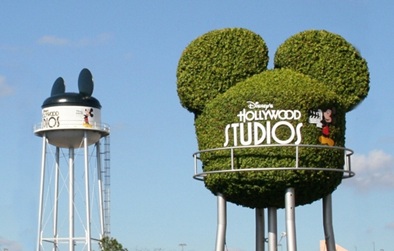
Hollywood Studios' Earffel Tower and Topiary tribute in 2008. Image retrieved from Wikipedia
The Earffel Tower was present in the park when it opened as the Disney-MGM Studios back in 1989. While the Earffel Tower was not a functioning water tower, it was based on the Walt Disney Studios Water Tower in Burbank, CA with ears added as a design flourish. This tower was located at the very edge of the park and was not a destination but added to the feeling that the park was a real Hollywood backlot.
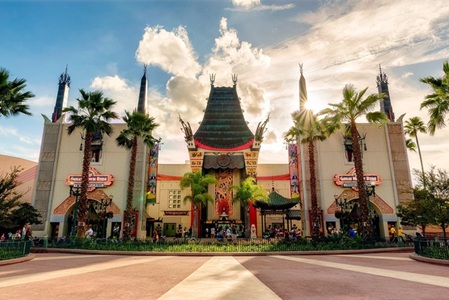
Image retrieved from disneyparks.fandom.com
In the center of the park is the second icon, the recreation of Grauman's Chinese Theatre. It’s centrally located, contains an attraction (currently Mickey & Minnie's Runaway Railway, formerly The Great Movie Ride), and is large enough to use as a visual landmark to help you navigate the park. Although the Tower of Terror is the visual icon for the park, appearing on merchandise along the other three park’s icons, the Grauman's Chinese Theatre, was there since the parks opening and is functionally, but not symbolically, the park’s central icon.
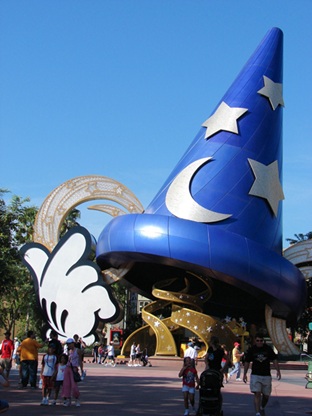
Image retrieved from Wikipedia
A fourth icon, the Sorcerer's Hat, a 122-foot version of the hat featured in Fantasia, was added to the park in 2001. Although the hat was removed in 2015 to declutter the central hub, and the Earffel Tower was removed in 2016 to make way for Toy Story Land, there was over a decade where the park had a range of four uniquely different icons. Even with just the two today, the park feels like a miscellaneous assortment of zones connected by a theme, contrasted by the sharp design philosophies of EPCOT or the Animal Kingdom. That said, it does work despite this in its own way. Film studios themselves aren’t theme parks: they are complexes to sustain the production of all types of genres. And in that way, Hollywood Studios succeeds.
Outside the park, it makes sense to use the Tower of Terror as the icon for marketing and merchandising purposes. Unlike the Chinese Theater, Disney imagineers designed the building explicitly for the park. It’s eye catching, timeless, evocative of the Golden Age of Hollywood, and a reminder that there’s at least one excellent thrill ride in Hollywood Studios.
Outside the park, it makes sense to use the Tower of Terror as the icon for marketing and merchandising purposes. Unlike the Chinese Theater, Disney imagineers designed the building explicitly for the park. It’s eye catching, timeless, evocative of the Golden Age of Hollywood, and a reminder that there’s at least one excellent thrill ride in Hollywood Studios.
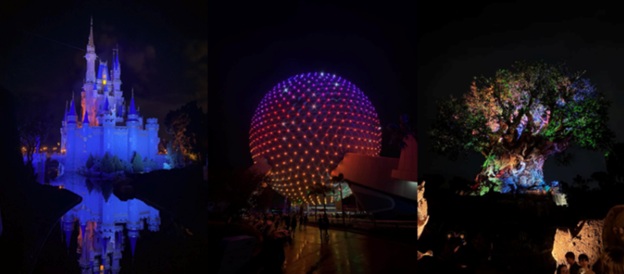
At night, the icons are illuminated, which is both visually striking and keeps them visible, so they keep on functioning as visual markers against the night sky. EPCOT’s Spaceship Earth is gigantic and otherworldly on its own, but at night it’s almost unbelievable to walk past. Truly stunning. I didn’t get a picture of any of the lit-up icons in Hollywood Studios since we closed out the night at The Hollywood Brown Derby.
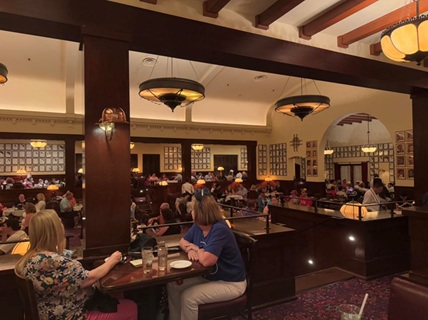
The restaurant is a replica of the famous Vine Street Brown Derby location which was a famous lunch spot for Hollywood stars and producers for decades before closing in 1980. It was frequently used as a filming location and was the birthplace of the Cobb Salad, invented by Robert H. Cobb, one of the restaurant chain’s founders. All four Disney World parks are littered with so many locations like the Derby, dense with history and a noteworthy icon in its own right. The large icons I’ve discussed here are only worth their salt because they do an excellent job unifying the parks and all the smaller attractions, bringing order and clarity through the chaos of long lines and busy crowds.
Next month I’ll be back with how wienies fit into our single-player digital spaces. Until then, I hope you’re enjoying the first few weeks of spring.
Sincerely,
Neil
Sincerely,
Neil