Originally published on April 30, 2025

Last month I went in depth discussing the iconic structures known as
wienies at the Disney World parks in Orlando, FL, and this month I’d
like to explore wienies in video game level design. Just as a quick
refresher, ‘wienie’ is a term coined by Walt Disney to describe any
prominent structure in a space that acts as a point of interest and
geographical landmark. Video games and theme parks are both fully
designed, interactive entertainment spaces so it makes sense that a
design principle from one would show up in another.
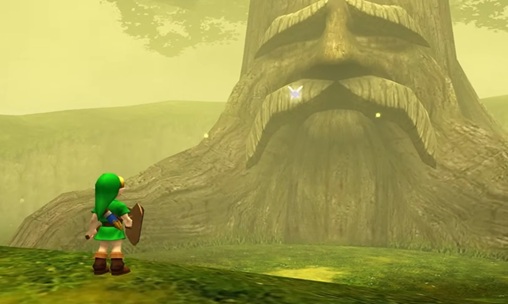
The first stop on our tour today is the Great Deku Tree from The
Legend of Zelda: Ocarina of Time for the Nintendo 64 in 1998, later
remastered for the 3DS in 2011. The Great Deku Tree is a giant
anthropomorphized wise old tree with a loud, booming voice, who
lives just outside the starting village. Once you have collected the
sword and shield, the narrow path to the Great Deku Tree is made
available. After encountering a few dangerous Deku Babas, the player
as Link turns down a stone corridor which empties out into a large
clearing housing the Great Deku Tree.
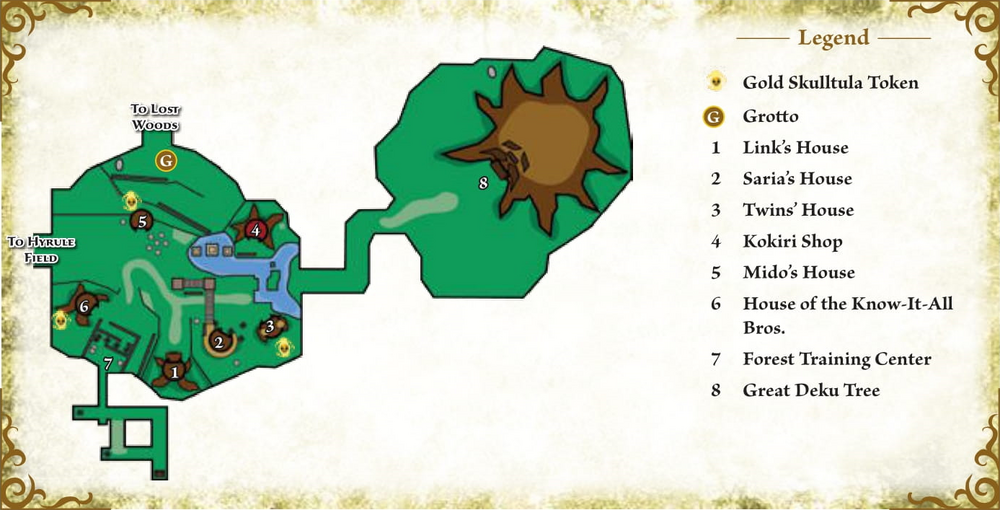
Map retrieved from The Legend of Zelda: Ocarina of Time 3D — Prima
Official Game Guide
This corner and eventual reveal of the Great Deku Tree act in the
moment as a camera pan, an example of the game borrowing from
cinematic language. In the book Designing Disney, lifelong Imagineer
John Hench writes that thinking cinematically was something they did
often when designing for the Disney parks:
In designing Disneyland, we thought of the park as if it were a
three-dimensional film. We wanted everything that guests
experience, not only the shows and rides, to be an entertaining
part of the story. This was a new idea: we took the most basic
needs of guests and turned them into attractions.
One of the first needs we considered was how to move guests from place to place. It was no longer a matter of the audience just walking through a cinema lobby into the theater to see the film.
One of the first needs we considered was how to move guests from place to place. It was no longer a matter of the audience just walking through a cinema lobby into the theater to see the film.
The Great Deku Tree’s reveal adds a moment of surprise and helps
accentuate the character’s size as the moment you first see him, he
is towering over you. Although many wienies are viewable from far
away, drawing your attention, the Great Deku Tree is not centralized
but a destination, much like the Hollywood Studio’s Tower of Terror.
Placing a wienie off the beaten path can add to its mystique and
perceived danger.
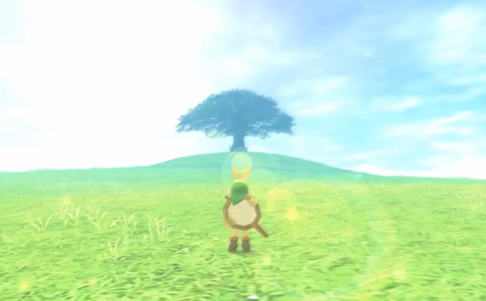
At the end of The Legend of Zelda: Majora’s Mask, Ocarina of Time’s
sequel released a few years later with a remaster in 2015, we get a
different type of wienie in the tree on the moon. I would struggle
to explain how and why this scene even makes logical sense within
the context of the game, but your journey to the moon and the tree
sitting serenely in an idyllic field sets the player on edge. On an
emotional level, you feel as if you may have transcended into a
dreadful purgatory, not knowing what horrors may await at the base
of the tree (spoiler alert: there are several). In contrast to the
surprise and delightful reveal of the friendly Great Deku Tree in
Ocarina, this area asks the player to run straight at the tree for
an extended sequence without action, only the sound of birds
chirping, your own footsteps, and the clanking of your sword against
your shield. It only takes twenty seconds to reach the base of the
tree, but you feel every last moment of tension. To use cinematic
language, this is an effective slow push-in dolly shot with no cuts.
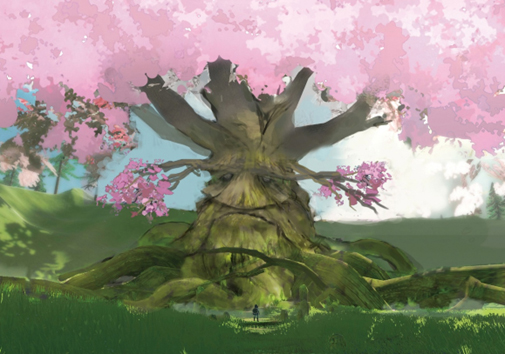
Concept art for the Great Deku Tree for Breath of the Wild
retrieved from
zeldadungeon.com
The next wienie on our tour is the Great Deku Tree from The Legend
of Zelda: Breath of the Wild. The Great Deku Tree appears in several
games in the Zelda series, coming in different sizes and
environments. This one can be found only after navigating through
the perilous Lost Woods. As you cross the threshold out of the Lost
Woods and into the Korok Forest, angled beams of golden light break
through the canopy above, the lively sounds of insects and wildlife
fill the air, and at the center of this new cozy environment sits
the colossal Great Deku Tree. Tucked away in this pristine grove are
several paths with their own trials and challenges, but at the
center sits the Great Deku Tree, acting as an icon for the peaceful
area, a talking NPC, a useful geographical marker, and home to a few
little koroks who live in a small tunnel within his massive trunk.
If Ocarina’s Great Deku Tree is the Tower of Terror, Breath of the
Wild’s is functionally closer to Cinderella’s Castle.
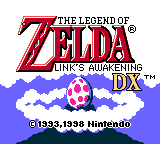
Wienie’s are not just for three-dimensional space. The Legend of
Zelda Link’s Awakening puts a mysterious wienie on its title select
screen. A surreal, simple, and iconic image – a large spotted egg at
the top of a mountain.
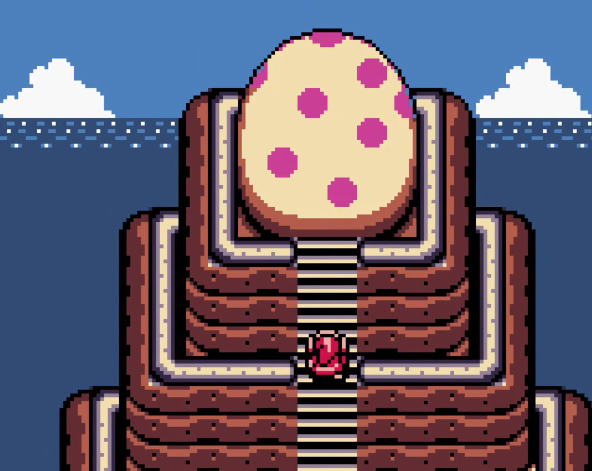
This egg not only acts as memorable location at the top of the
game’s map, but it’s a lovely curiosity that captivates the player
at any age. We all know that eggs hatch, but why is it there and
what could be inside? You soon find out that it is the egg of the
Wind Fish, a fact that really only presents more questions, and that
the game’s setting, the island of Koholint may just be a
manifestation of the creature’s dream.
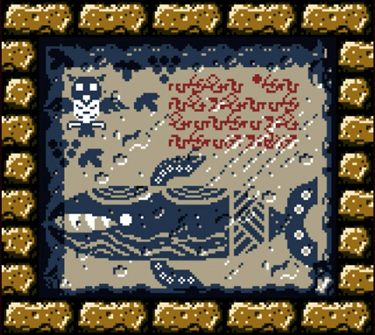
The game’s symbolic icon, the Wind Fish’s egg, functions much like
those in the Disney parks. It’s a towering structure with bold and
memorable visual design that acts as a point of interest, a
convenient geographical marker, and a destination in and of itself.
What secrets does it hide? You’ll have to play the game to find out!

As a side note, I’ve heard that the developers of Link’s Awakening
were big fans of David Lynch’s Twin Peaks, a show that had its own
cultural moment
in Japan, and that the show’s strange and dreamlike tone helped
inspire some of the game’s narrative decisions. Additionally,
according to the
Gaming Historian’s account of the game’s inception, the game started as an experiment to see what it might look like
to port the SNES’s A Link to the Past to the Game Boy. Several
employees of Nintendo started an “unofficial after-school project,”
tinkering outside of regular office hours to see if a Game Boy Zelda
title had legs. With both of these facts in mind, it’s not
surprising the title has a strong unique identity that sets it apart
within the series.
And now, the final stop on our tour of video game wienies: the
island of Myst…
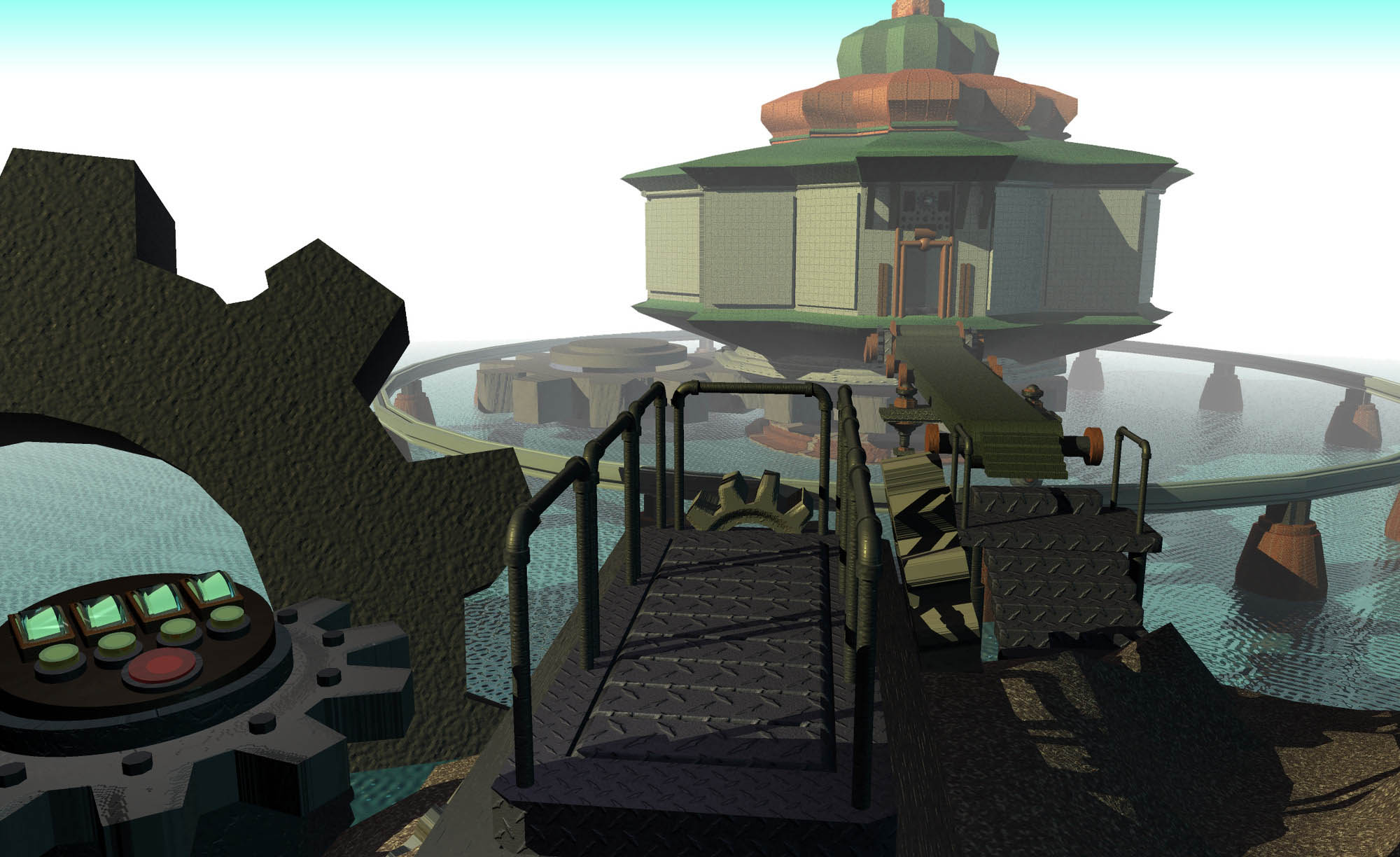
Cyan, the studio behind the Myst series, is the king of mysterious
game wienies. Before playing either Myst or Riven I knew these were
worlds I wanted to explore based on the cover art alone – depicting
curious architecture and imagery that sparked something in my
imagination. Myst with its island densely packed with mismatched yet
purposefully organized architecture and Riven with its bulbous
glowing tree firmly planted in a barren wasteland - like Disney’s
Tree of Life with a cancerous alien growth. Curiosity is curiosity,
and a wienie promising dark secrets can turn just as many heads as
EPCOT’s Spaceship Earth.

Back in 2013 Robyn Miller, who co-created Myst with his brother Rand
and is responsible for both Myst and Riven’s haunting music, gave a
talk at the Game Developer’s Conference titled
Classic Postmortem: The Making Of Myst. Their early games, including Myst, were developed on a program
called HyperCard for the Apple Computer. The program
programmatically joined a database and virtual card-filing system
that, at the risk of sounding reductive, is comparable to an early
version of PowerPoint. The game involves clickable mostly-still
images that bring you from one static location to another, not
unlike Google Street View. But as John Carmack was working on
pushing the boundaries of how speedy a game could go with Id’s
lightning-fast DOOM released just a few months after Myst, brothers
Rand and Robyn Miller crafted a beautifully pre-rendered puzzle box
that was rich with art, story, and some compelling motion video
sprinkled throughout. Instead of DOOM - and my apologies for a
horrible pun but I can’t help myself - they gave you MOOD.
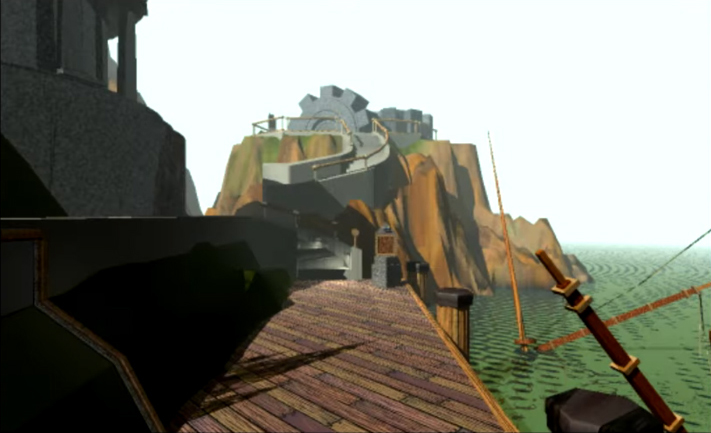
The architecture would mean little without the narrative and
creative - if not sometimes frustrating - puzzle design, but the
Disney parks too are not plots of land with interesting looking
buildings, but a fully realized and engaging play space. The wienies
are both an experience and an advertisement for an experience, and
the more one pays off, the rest become that much more enticing.
When the Miller brothers first tooled around with HyperCard, they
started with a linear progression of images within their visual
narrative but soon found themselves crafting branching paths "as if
the medium was calling out to be nonlinear."
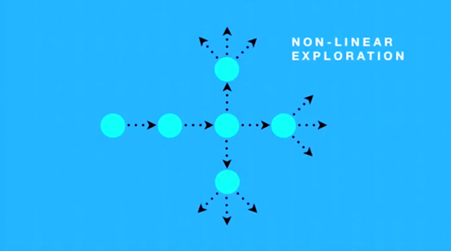
A graphic from Miller’s GDC talk visualizing the pathing of
non-linear storytelling.
The Manhole (1988) was their first commercial game, a fully
illustrated point-and-click first person experience for a younger
audience. They released a handful of children’s games before being
approached by the Japanese company Sunsoft to pitch a game geared
toward adults. Instead of making the game for a PC, Sunsoft
requested they develop one that would be playable on a home video
game console. In his talk, Miller discusses how these limits would
affect their production:
Game machines had no hard drive buffer and a very small memory
buffer. So we had to design around that for Myst. That was an
interesting design restriction. So how do we design around that?
We had to load different pieces of Myst…we had to compartmentalize
Myst, which we did by creating ages [separate sub-worlds]. This
works really well for design. Probably a lot of game makers have
discovered this along the way. A lot of designers have discovered
this along the way as well. Just to fit pieces of a thing in your
mind and to know there’s one central place. If you think of
wandering around Disneyland, you know there’s always that one
central location and then you go out to all these different areas
and you always feel like ‘ah, okay, I can always no matter what,
if we get lost, we can always go back to that central location.’
It's interesting that Miller stumbled into this type of design as it
emerged within the technical limitations of the project. I don’t
think that’s a coincidence, and I’m sure if I studied up on garden
design and ancient towns I would discover similar design principles
at play.
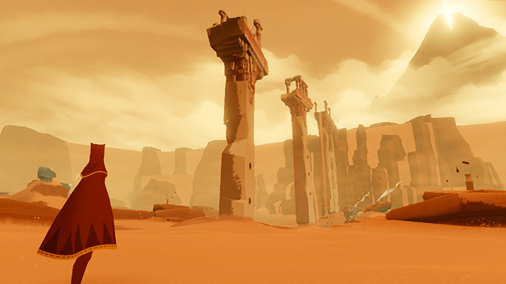
But getting back to video games, I gave just a drop of examples from the ocean of video game wienies. Some of my favorite examples not listed above include the mountain in the game Journey, the touring craig that you spend the entire game inching toward.
But getting back to video games, I gave just a drop of examples from the ocean of video game wienies. Some of my favorite examples not listed above include the mountain in the game Journey, the touring craig that you spend the entire game inching toward.
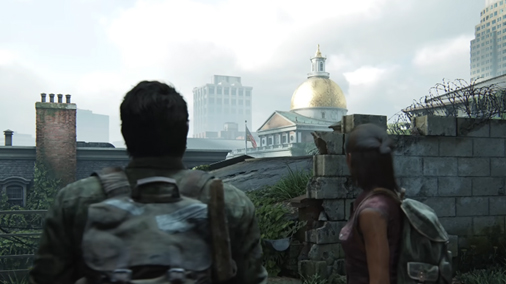
And an honorable mention to Boston’s own State House in the Last of
Us, a real-life location that both works as a wienie and adds a
level of verisimilitude to the world’s design.
Development on Sad Land is still going strong. I plan to devote my
next newsletter with some updates on the project that I’m very
excited about sharing. Until then, keep your eyes peeled for wienies
and enjoy the spring.
Sincerely,
Neil